This might not look like it is about lifejackets but read on – I always try to make things interesting!
Eric Tabarly more than anyone is responsible for the professionalism and money that is involved in all those round the world yacht races you read about. He transformed it from the very basic levels in the early sixties when he started to be involved to what we see now.
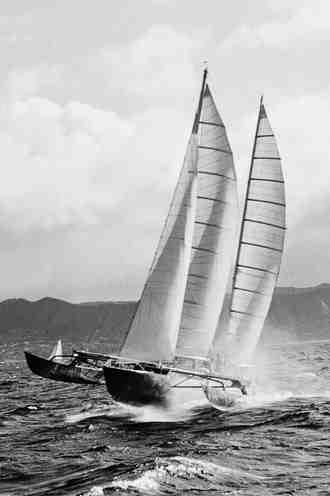
He was also more than anyone responsible for increasing the size and power of boats that can be handled by one or two people – he virtually invented or facilitated every aspect of that side of the sport.
He is the guy who brought the money in – he developed the modern notion of water ballast in the late 1960s. He built the first really big multihull for single handed racing. Dinghy type rigs on yachts, deep bulb keels, light displacement, aluminium.

He has held more records than anyone. His boats were almost the most radical – with each evolution he was the one that everyone said had “gone too far and would find it impossible”.
He never did. Consummate seamanship – this guy was no cowboy.
He learned to sail on a wooden boat owned by his father – Pen Duick – all his boats were called that.
About a decade ago he bought back the original wooden Pen Duick with the aim of restoring it but it was in too poor condition. So he used the original boat as a plug to create a fibreglass hull (beautifully put together) and then fitted it out properly with wood. No dollars spared. But he didn’t want to uglify the beautiful lines of the boat by fitting lifelines – the wire fence around the outside.

Taberly also never wore a life jacket – he had his hands and his wits. Hundreds and thousands of sailing miles – millions – in often tricky difficult boats.
Then there was the sad story from the newspaper when he was lost overboard.
Wonder what he was thinking over the next few hours …
| ACCOMPLISHMENTS (a very abbreviated list – it misses two of his boats completely! Pen Duick V and Pen Duick VI):1964 Won OSTAR Race in Pen Duick II breaking Sir Francis Chichester’s record by 13 days, 9 hours completing the crossing in 27 days, 3 hours, received Legion d ’Honneur 1964-8 Built Pen Duick III and the large trimaran Pen Duick IV 1967 Won all the principal races of the Royal Ocean Racing Club in Class One, including first overall in Fastnet and line honors in the Sydney Hobart Race sailing Pen Duick III. 1969 Won TransPac with Pen Duick IV in 8 days 13 hrs, setting a new record. 1973 Whitbread Round the World Race, 2nd place. 1976 Won OSTAR Race in Pen Duick IV besting Alain Colas‘ Club Metiterranne (a 236′ schooner) by seven hours 1984 Voted most popular sports figure in all of France 1985 Inducted to Single-Handed Sailors’ Hall of Fame 1994 Whitbread Round the World Race- 7th place |
In this situation the typical action would have been to either
1/ With the rising wind everyone should have had their lifejackets on already.
2/ To put lifejackets on before moving onto the deck to make the sail change – maybe it takes about 15 to 20 seconds.
Your Skill Can’t always Protect You
I have had two boats break under me – major structural failures – both racing sailing boats. I’ve had big bits of boat break off under sailing loads several times. I’ve been dismasted around 11 times in my racing career.
Two of the times the boat broke I didn’t have my lifejacket on. Every other time I have. Because of that experience.
If the weather is really fine the wind not very strong the sun is out and the water is warm and I know the boat well then I might – just – decide to put my lifejacket in the cockpit within reach. The moment any of these factors change – I put it on.
Types of PFD (Personal Flotation Device)
PFD 1- used to be called a life jacket. It is designed to float an unconscious person with their face up out of the water so have a bulky neck. The better ones have a flexible neck to not impede movement or comfort. They have to be a bright colour. General use is in yachts, when travelling in isolated areas and when not under supervision.
PFD 2 – used to be called a bouyancy vest. They won’t turn you upright if you are unconscious but are flexible and comfortable. They have to be a bright colour. Common use is in small boat racing or sailboard racing which happens under supervision.
PFD 3 – same as PFD2 but they don’t have to be a bright colour. Common use is for canoing or kayaking where the boat is being used not far from shore – like in a narrow river or stream.
Sailing Dinghy racing rules require that you wear a PFD2 (it doesn’t have the bulky neck) for most events though some require a PFD1. PFD2s are generally accepted by the general boating authorities too for small boats and windsurfers – but check. It is worth spending a little bit of money on a lifejacket that is flexible and light – is just makes it easy to wear. Cheap ones are awful.
If you are using a trapeze (where the crew is suspended horizontally from a wire on the mast with their feet on the side of the boat) you need a slightly higher cut PFD that keeps the area of the trapeze hook clear for action.
A big advantage of wearing a comfortable PFD is that on bigger racing boats or unfamiliar boats they can save you a lot of bruises.
Two more notes. Getting kids to wear Lifejackets/PFDs
In other words … I know this could be me.
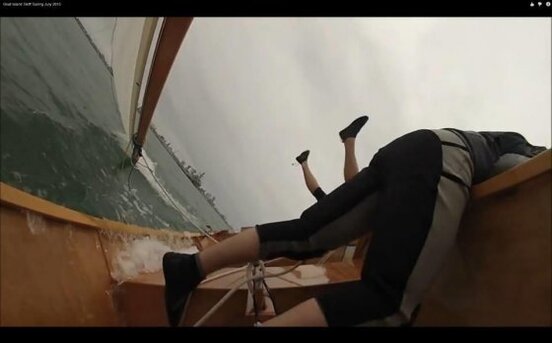
The biggest reason that people don’t wear lifejackets is either that they “just don’t like the idea” or that they are thinking “nothing will happen to me”.
1/ Human beings can get used to anything. In a car I feel naked without a seatbelt and on a boat I feel naked without a lifejacket. Tie a dog up before you feed him and he will look forward to being tied up.
2/ The most vulnerable people (kids or beginners or poor swimmers) are often the most reluctant to put on their lifejackets. As soon as I put MINE on there is no excuse left for them.