
Will golfball dimples make a boat hull, surfboard or sailboard go faster? The problem is that it’s not just the dimples making the golfball go further. Spoiler – it is the spinning and dimples together.
For a boat hull, the practical way to reduce drag is a fair, smooth surface that keeps laminar flow going for longer, particularly on the foils and the front part of the hull.
It works because as the ball rotates with backspin because of the slope of the club’s face it pulls air over the top in the backwards direction and underneath in the forwards direction.
This means the effective air velocity over the top is increased and that underneath is reduced.
Sound familiar?
Yes, it is the same way a wing gets lift. The faster airflow over the top reduces pressure because of Bernoulli and the opposite happens underneath. The ball is really flying something like a wing .. it is gliding.
The old story about a “wing being longer over the top so the air has to go faster is wrong. Otherwise sails, bees, dragonflies, paper planes and balsa gliders which have the same distance both sides of the wing wouldn’t be able to fly.

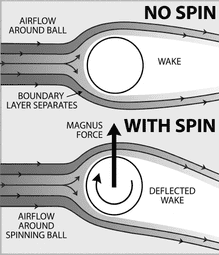
You can see the flow is symetrical and doesn’t alter the direction of airflow around the surface.
So below we have a ball with no spin – the air/fluid around the ball has symmetrical flow. But if we spin in then it drags the air faster over the top and slows it down over the bottom with the result that the airflow deviates down. This is a sign (not a thorough explanation though) that if the air is going down, then the equal and opposite force has already been applied to the ball to keep it up.
So if you plan to spin your boat and it is ONLY in Air or only in water without touching the other … you might just be on to something!
So how does a flat plate manage to fly in the case of a paper plane or insect? It is because natural systems always work to minimise energy. At large angles to the flow the flat plate nature has no choice and generates a large wake of turbulent vortices. The wake has a lot of energy but it is randomised or may form a wake of Karman vortices off each edge and rotating in opposite directions. We sometimes see this when using an oar or paddle.
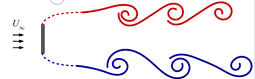
But at small angles to the flow nature has another choice – drop a single vortex behind the plate (a “starting vortex” which blows away downwind and the opposite vortex is around the flat plate (or airfoil) and carried along with it. This sheds much less energy from the system.
This results in a radical change in the flow around the flat plate which now becomes asymmetrical like the flow around a rotating golf ball and is carried along by the flat plate or airfoil. Different method, but same circulation phenomenon.
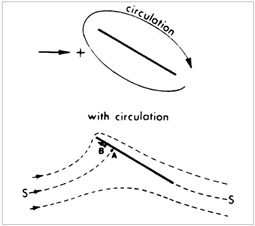
This is a computer simulation of flow around an airfoil showing the starting vortex. It is a pity it doesn’t start a few seconds early to show low lift around the airfoil until the starting vortex is dropped and the opposite vortex becomes circulation around the airfoil.

Video image can take a moment to load.
For those wanting more complete explanations for sails master Arvel Gentry’s articles are strongly recommended.
OK … I get the spinning but why do golfballs have dimples
There are two types of flow. Sometimes when the flow from a tap is low it forms an almost perfectly smooth shape – all the different water particles are moving parallel and none of the streams mix.
When water moves faster the stream gets lumpy and broken lower down or if the flow is increased.
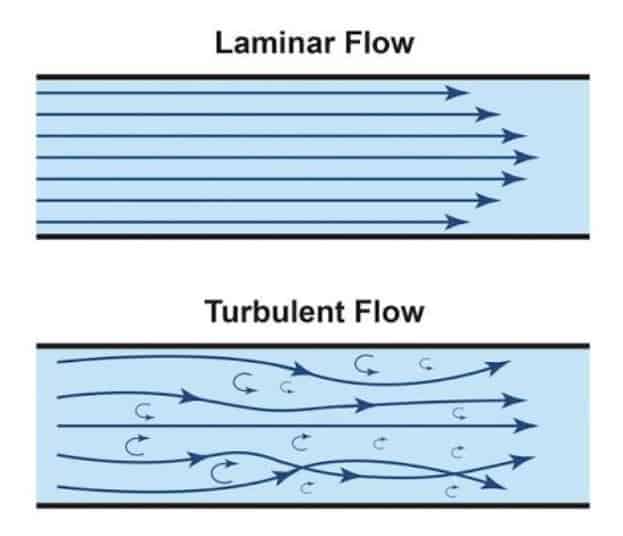
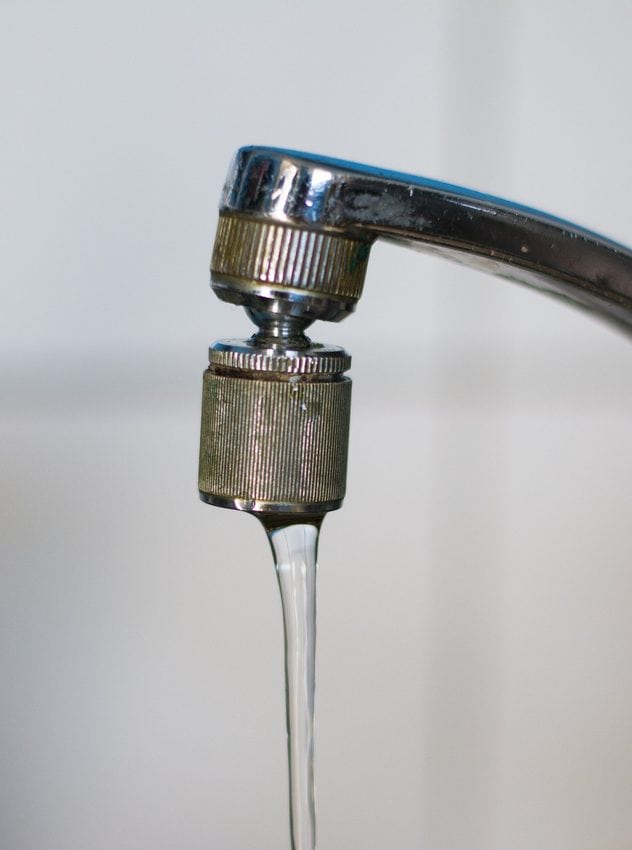
Laminar flow can also be broken/tripped into turbulent at lower speeds if the surface it is moving along is rough or dirty.
For air or water flow over an object there is much less drag from laminar flow.
Imagine a perfectly smooth golfball made with no dimples new out of the factory. It has been hit a few times which have created some tiny surface irregularities and has some small particles of dirt attached. These trip the flow from laminar where the air first contacts the ball to turbulent so drag can be quite different as the ball spins with the drag moving around very irregularly.
The ball is much less likely to go straight.
The purpose of the 300 to 500 dimples is that they provide a consistent tripping point on all sides of the ball for the flow to change from laminar to turbulent. So the flow around the ball is more consistent and it will fly straighter without veering too much in one direction or another. It never seemed to work for me!
If there is slight deformation from a club or small amounts of dirt the dimples are relatively larger so they dominate the behaviour of the airflow around the ball. At least enough that the golfer will see that the dirt is building up and clean the ball in one of those whizzy handled devices or (legally) change the ball.
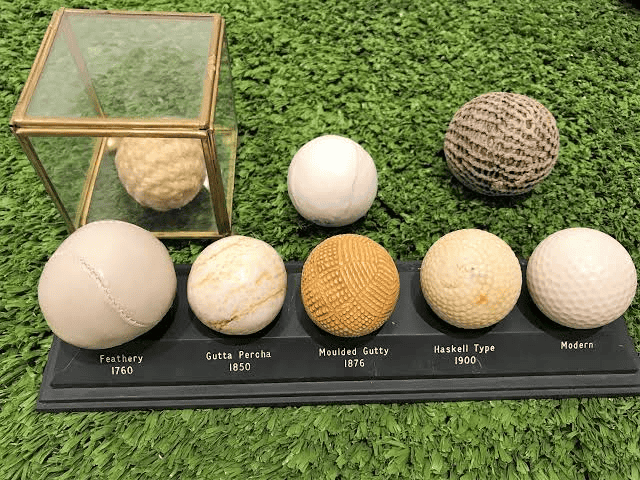
What is the better solution to reduce hull drag in a practical way
There have been numerous attempts to get some “super surface” to work by reducing turbulence and vortices and keeping the smooth (laminar) flow at the beginning of the hull going for more of the hull length, but no simple methods have proved practical.
The best solution is a surface that is FAIR. Smoothness at the building level and then finished with a smooth surface as well.
There is not a lot of difference between a nice paint job or a nice paint job plus sanding with about 400 grit wet and dry sandpaper and water using a sanding block – NOT hand held.
This is particularly true for the first part of the hull and the first part of the foils. The water gradually moves from smooth (called laminar) flow to turbulent flow.

Like a tap running just slightly faster than dripping so there is a stream. The first part is beautiful and smooth, almost mathematical, but a little further down towards the sink the stream of water suddenly becomes unsteady as roughness and turbulence appears. This is inevitable. Laminar flow is delicate and easily disturbed.
There is less drag on the hull from the smooth laminar flow. So it is better to have as much as possible.
So it is a good idea to get rid of roughness of the hull that can break the laminar flow. It will break into turbulent flow, but we want as much laminar flow as possible.
Laminar Flow with the Lowest Effort
Practically this means that with foils in particular and maybe the front part of the hull it could be sanded. They say spend about 70% of your time getting the first 30% of any boat surface smooth.
Personally I would almost ALWAYS sand foils but usually just try to get a nice paint finish on the hull.
I did see that “Mythbusters” found otherwise with a full sized car. Mythbusters is entertainment and only moves into the area of science occasionally where it won’t spoil the story. Testing flow and drag with something as complicated as a car is very tricky. A dimpled car just possible might have some local effect that might smooth some local drag.
For example if the air going over a particular car normally suddenly changes from smooth flow to turbulent going over the top of the windscreen causing a lot of drag. It is possible that just through luck the placement of dimples might reduce that drag. Particularly if the dimples are the right size and just the right position. That’s why such testing is normally done with much simpler shapes. To avoid secondary effects messing up the experiment. Plus car engines vary, driving styles vary and so on.
If dimples did reduce drag in this way, then Boeing and every cargo carrying ship would have been using it for years. But it don’t, so they don’t.
If you want to get into wing theory a bit more and want to know why it really works, you need to read Arvel Gentry. Who I read when I was about 14 and digested over a couple of years.
He caused so many arguments at the time because people were reluctant to give up the old ideas of “flows faster because of longer distance” and the “air accelerates in the slot between the mainsail and jib” which had been held for a considerable time by aerodynamists and others that should have known better.
Start with Arvel’s “the origins of lift” and work your way through it on Arvelgentry on jimdofree.
Hope this helps present an overview of why dimples work on golfballs and how to harness some of the same understanding to improve the performance of sailboat hulls and to some extent rigs with some careful work.
Boat design articles on hull performance
Boatbuilding FAQ on plywood, epoxy and fibreglass
