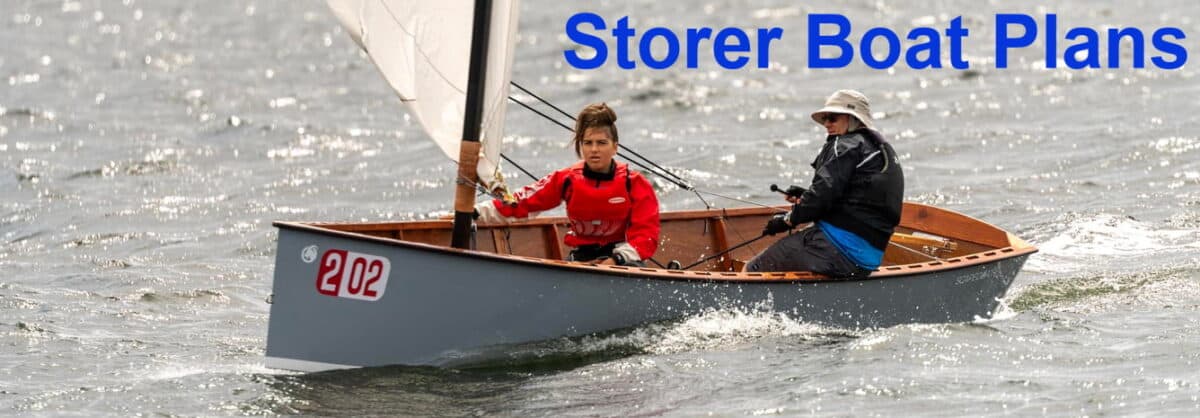
Goat Island Skiff Launching 4 – Christophe in New Hampshire
“Disposable” Canoeing – building a canoe in a few hours.
I don’t have a car so how can I go canoe touring? Its something I fell in love with in the USA on Lake Powell.
This is an idea for a simple, cheap, almost throwaway (or give away) canoe. I can get the materials shipped to somewhere on a river, build the boat over a couple of days then go for a paddle.
At the end I can give the boat away or store it for the next part of the trip. Podcast online – Michael on why Australian Boats are Different – 3 of 3
Podcast Online – Wooden Boat Construction by Michael Storer – 2 of 3
This is the second of my talks in the USA. It focuses a bit more on construction and some of the methods that can be used to keep a boat light and simple, but very strong and stiff.
It also discusses how there is a “creep” in boatbuilding and design that increases the weight of boats way over what is really needed for a strong structure. Stretched version of the OZ PDR – the 12ft PDGoose
The PDRacer international forum started discussing a longer version of the humble PDRacer – and I had some drawings on hand already for a 12ft version because of Bob Alston. He actually thought up the name, which I quite like. We really do recommend the OZ PDRacer for most people and you do need to read more → Q&A – gluing endgrain – including Plywood and Scarfs
Gluing Endgrain Gluing timber end grain with epoxySee drawing of endgrain right.. The basic problem is that end grain is highly absorbent so it can steal the resin from the join leaving insufficient for good bonding. The trick … is to feed the end grain some mixed resin before the glue mix is put on read more → Q&A – Should I use coarse sandpaper on timber or ply to make the epoxy stick.
There was the suggestion that very coarse sandpaper was the best to use on a timber surface to ensure good bonding when gluing or fiberglassing the surface. This is not recommended – the following explains why. There was the suggestion that very coarse sandpaper was the best to use on a timber surface to ensure read more → Q&A Why hasn’t the epoxy cured – coating gluing glue
This is a problem most of use come up against at least once. However it is unlikely to happen a second time. Richard wrote to me asking why his epoxy was still soft 3 days later. He suggested it might be because of one of: 1. The immediate guess is that it’s been too cold read more → Teak Decks and Sikaflex, 5200 etc
There are two tricks to sikaflexing between strips. Use the Sika Primer – it improves the bond strength to the timber for a permanent job. You can get away without it often, but it changes the situation from a fairly strong bond to a hugely strong bond (you’ll know this if you have ever removed read more → Q&A – Cordless drills to replace wood clamps and cramps in boat gluing and assembly
Most people know about using Cordless Drills to drive screws into timber now, but I remember when it was new and exciting! Here’s my spiel from my plans sets Cordless Battery Drill with Clutch. A marriage made in heaven. The drill can be battery (most convenient) or mains powered. It is best if it has read more → Q&A – Painting and Varnishing Epoxy
Paint vs Varnish Paint is more durable and will protect the epoxy and timber the best. Varnish hides a rough surface better. If you have done a rough job the timber grain will hide it. Make sure the varnish contains ultra-violet filters. Us My usual plan is to varnish the inside of open boats and read more → Q&A – Reducing labor and waste when using epoxy
There are a number of labour and materials saving techniques that are applicable when using epoxy. Contents of this section Wet-on-Wet Coating and Dewaxing Cured Epoxy. Building strong lightweight boats – a note on the use of epoxy One Hit coating and gluing Wet-on-Wet Coating and Dewaxing Cured Epoxy. As epoxy cures some of the read more → Q&A – Using Snap-Lock Plastic Bags for Epoxy Filleting and Gluing – less mess, less waste
The two methods here save a lot of mess when building boats with epoxy. They also allow accurate and fast placement of mixed epoxy glue. Most supermarkets have varieties of “snap lock” bags. They have a seal across the opening of the bag that can be pressed together with finger pressure. They make it a read more → Q&A – Saving time by precoating plywood sheets with epoxy.
If ply sheets are precoated it saves lots of time. It is easier to coat areas on the flat Gravity works with you to keep the coated surface level so there can be no runs. It is easier to get an even distribution of epoxy on the surface There is much less chance of missing read more → Q&A – Fibreglassing method 3 – Method for large areas
Fiberglassing larger areas is done differently from small. Large areas require that the glass be draped dry over the surface then the epoxy is applied over the glass and worked through the surface. The example here is glassing a centreboard but the principle is the same for much bigger areas like the bottoms, sides and read more → Q&A – Fibreglassing method 2 – Double bias tape for curved surfaces
Where a seam has to be glassed and it is difficult to make the glass sit flat because of a complex curve then a double bias tape is used. It is also useful for complex 3D curves like the tips of centreboards and rudders. Commercial double bias tapes can be bought but you can make read more → Q&A – Fibreglassing method 1 – small areas
This is the normal method for fibreglassing small areas – typically using fibreglass tape to hull seams. Here I document the process of coating the hull and glasstaping the chines in one hit. Integration of different steps in this way is one of the major efficiencies of modern epoxy boatbuilding. However if simply glass taping read more → 

