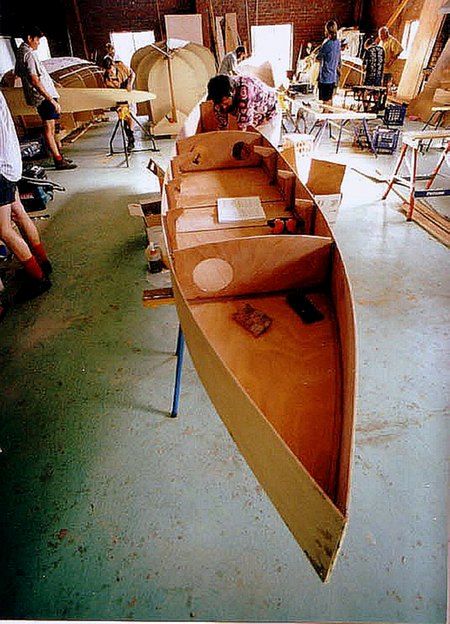
Helping out at the Duck Flat boatbuilding spring school.
PJ and Cliff build a plywood Quick Canoe for the Tinaroo Raid in one week
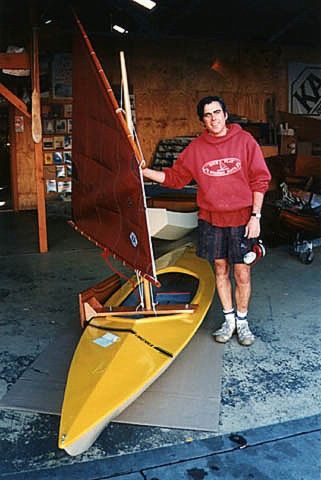
Cliff and PJ live in Warm Queensland and Wintry Tasmania. However they both like to go the the yearly (June) wooden boat festival in tropical Far North Queensland.
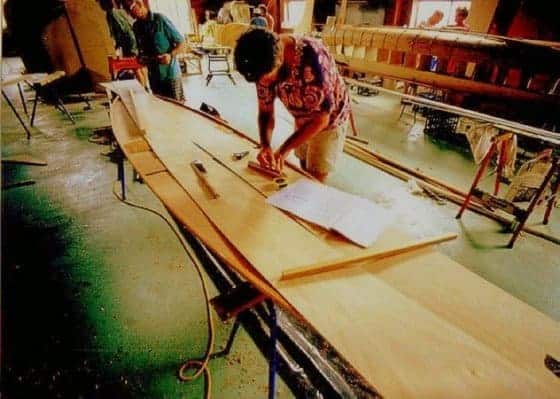
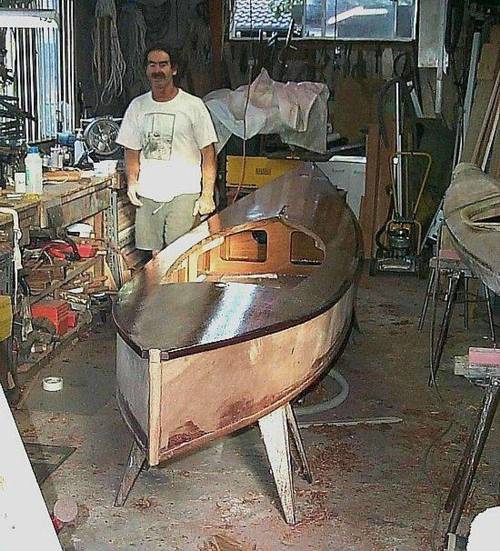
This year they decided to build one of my Quick Canoes. They started on Saturday and finished including putting the canoe on the car roof by the following thursday.
They are experienced woodworkers so added some very nice details.PDGoose DIY sailboat Pics from Jim Post
First Goat Island Skiff Kit sold in the USA
Clinton Chase in Portland Maine has just delivered a precut kit for the Goat Island Skiff to John in Texas who is building the boat.
The kit arrived in a big box.
This little article tells how his kids are involved in the boatbuilding starting with attaching the framing to the accurately cut plywood. He knows the rule that it is more important what the kids learn and experience than it is to minimise the use of wood!First Goat Island Skiff Plywood Sailboat in Chile
First baby of the New Year – Handy Punt.
Fiona Harbison and friends have just launched their new Handy Punt for fishing and family outings.
Fiona is the sister of Helen (hope I have that right) who built a Nutshell pram in a number of the Duck Flat spring or autumn boatbuilding schools.
It is called Farnark, which will strike a chord with Australians and New Zealanders through the work of John Clarke. There is a picture of the boat and a clip of John Clarke reprising his farnarkling spiel.New article out on PDRacers on Duckworks.
A nice little article by Jackie Monies who is turning into the writer in residence for the PDRacers.
It posits the idea that because of its cheapness, ease of building and the creativity in the group that it qualifies as the “All American Boat”.
Actually I think it is the perfect boat for places that are water rich and cash poor. Anyone can afford to go sailing in these cool little sailing boats. The options of material and design solutions allow the boats to be built of local material just about anywhere. Very cheaply.Podcast online – Michael on why Australian Boats are Different – 3 of 3
Podcast Online – Wooden Boat Construction by Michael Storer – 2 of 3
This is the second of my talks in the USA. It focuses a bit more on construction and some of the methods that can be used to keep a boat light and simple, but very strong and stiff.
It also discusses how there is a “creep” in boatbuilding and design that increases the weight of boats way over what is really needed for a strong structure.Podcast Online – Wooden Boat Design by Michael Storer – 1 of 3
This talk is the first hour of my exposition on boat building and design. There are two more parts to come. This covers some of the background and design issues. The second is more on the building side and the last is a bit more about why the Australian (and New Zealand) wooden boat tradition is different from the Northern Hemisphere.
You can stream the talks over your internet connection or download them as a podcast.Q&A – gluing endgrain – including Plywood and Scarfs
Gluing Endgrain Gluing timber end grain with epoxySee drawing of endgrain right.. The basic problem is that end grain is highly absorbent so it can steal the resin from the join leaving insufficient for good bonding. The trick … is to feed the end grain some mixed resin before the glue mix is put on read more →Q&A – Keep epoxy warm for good handling – Lightbox
There are huge advantages in keeping the epoxy at a slightly raised temperature. * It flows out better onto the work * It mixes easier * The curing kicks off faster in cold weather (and the box can easily only be turned on when needed. There are huge advantages in keeping the epoxy at a read more →Q&A – Should I use coarse sandpaper on timber or ply to make the epoxy stick.
There was the suggestion that very coarse sandpaper was the best to use on a timber surface to ensure good bonding when gluing or fiberglassing the surface. This is not recommended – the following explains why. There was the suggestion that very coarse sandpaper was the best to use on a timber surface to ensure read more →Q&A Why hasn’t the epoxy cured – coating gluing glue
This is a problem most of use come up against at least once. However it is unlikely to happen a second time. Richard wrote to me asking why his epoxy was still soft 3 days later. He suggested it might be because of one of: 1. The immediate guess is that it’s been too cold read more →Teak Decks and Sikaflex, 5200 etc
There are two tricks to sikaflexing between strips. Use the Sika Primer – it improves the bond strength to the timber for a permanent job. You can get away without it often, but it changes the situation from a fairly strong bond to a hugely strong bond (you’ll know this if you have ever removed read more →Q&A – Cordless drills to replace wood clamps and cramps in boat gluing and assembly
Most people know about using Cordless Drills to drive screws into timber now, but I remember when it was new and exciting! Here’s my spiel from my plans sets Cordless Battery Drill with Clutch. A marriage made in heaven. The drill can be battery (most convenient) or mains powered. It is best if it has read more →Q&A – Reducing labor and waste when using epoxy
There are a number of labour and materials saving techniques that are applicable when using epoxy. Contents of this section Wet-on-Wet Coating and Dewaxing Cured Epoxy. Building strong lightweight boats – a note on the use of epoxy One Hit coating and gluing Wet-on-Wet Coating and Dewaxing Cured Epoxy. As epoxy cures some of the read more →