A new book out by Kiwi Richard Blakey is truly exciting for those interested in performance yacht design. There is even a wooden boat angle.
Click on the cover photo to order the book!
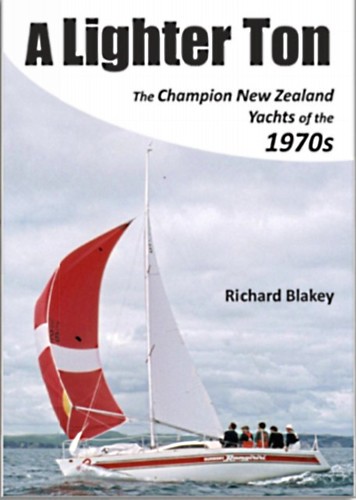
A Lighter Ton – is the story of how a bunch of tremendously talented boat designers, mostly from New Zealand revolutionised yacht design through the ’70s.
Almost month by month, International regatta by International regatta new and radical boats from Sweden, Denmark, England and New Zealand challenged the status quo with boats that were exciting, cheap and for most of the first part of their developments were built of wood.
As Dinghy Design influenced yacht design the changes influenced many of us would be designers
As a teenager drawing boats on any available piece of paper I followed the developments like rooting for a sports team. Radical new designs from Bruce Farr (towards the bottom of this list), Paul Whiting, my favourite Laurie Davidson, Murray Ross and some of the early Greg Elliot designs.

Dynamic change … boats that could hang in upwind against the old heavier types from Sparkman and Stephens and Dick Carter and the newer heavy but less heavy than before boats by Doug Peterson and Ron Holland. The older boats focussed primarily on upwind sailing and left an unexploited area in terms of downwind performance. Existing boats were “bogged down” and would only plane briefly when there were waves to surf on. The new boats could plane freely.
Here are a bunch of other books that formed the way I think about design, construction and sailing.
Building Skill Levels were high in New Zealand.
A lot of the potential was also because of the New Zealander’s skills in building in timber. This photo is from the bow section of Mr Jumpa by Farr

The structure presages composite yacht design with a rigid skin made up of three layers of timber veneers supported by close spaced stringers on the inside. The rest of the structure is fairly minimal because of the skin rigidity – a few ring frames a couple of full bulkheads and basic bunkfronts and cockpit sides and tops to stiffen up the structure.
Mr Jumpa was sponsored by a NZ wool company … that wasn’t allowed to sponsor using quite its own name. “Jumper” is an antipodean word for woollen sweater or pullover! There was also Swuzzlebubble (sponsored by a soap company) and Red Lion (named for the logo of a brewery), Rope Runner (a sailing rope company).

This is a lines drawing for Newspaper Taxi by Whiting. The chap that built my first custom built racing dinghy, Ian Bashford, was racing on it out of Middle Harbour yacht club in the late ’70s. It was on a mooring visible from the main road. Its wide stern, bow down trim (without crew and to cheat the rule) and super thin racing dinghy like mast were radical. In this drawing you can see the distortions of the side panels of the boat to fit the rule which was forever being evolved to try and make this new style of boat less competitive. The powers that be should have just accepted the new concepts as the rule collapsed under the weight of amendments and compromises. And the boats that people want to sail went this way anyhow.

Yacht design has been rarely quite so interesting! I recommend the book!
Other Books About the Development of Light New Zealand yacht design and construction

FREE PDF – detailed history by Gary Baigent.
Baigent documents how New Zealand boatbuilders rejected weight-limiting international regulations in favour of high-performance, light-displacement craft. The text uses line drawings and technical profiles to contrast old-school displacement formulas with local hull configurations capable of high-speed planing.
The focus is the 1970s lightweight racing boom, a pivotal era when local designers used alternative materials like plywood to challenge the established yachting order. Baigent tracks how innovators Bruce Farr, Laurie Davidson., Paul Whiting, and John Spencer blew the doors off Yacht racing.

A comprehensive history of yacht design in New Zealand as seen by one of the country’s leading designers. 298 pages in full colour with plans and drawings. This book covers a unique period in the history of yachting and boating in New Zealand that happened to coincide with Jim Young’s life as a boatbuilder/ designer/ yachtsman. It was an era that saw dramatic advances in design and construction technology from what was an ancient craft, steeped in tradition, unchanged for centuries, to a time when boat builders have had to relearn the trade completely as wood has been steadily replaced by synthetics. This book lays out Jim Young’s boat building career from his boyhood canoe made of roofing iron and tar to some of the most successful boat designs in New Zealand maritime history.

‘Southern Breeze’ takes the reader on a rich and varied journey from the great yachts of the Logan-Bailey era, through the golden years of the first decade of this century, the popularising of centre-boarders, and the postwar explosion of new designs, to the international successes from Rainbow II, to the Olympic, Whitbread and ultimately America’s Cup glory.
The very readable text is richly illustrated with a combination of paintings, postcards and photographs, many of them previously unpublished.
Please recommend other books in the comments. Books specifically.
Looking to buy a Nz book called A Lighter Ton
Can anyone help me find a copy.
I think some of the online used book dealers might be the best source. It’s not as nice but it is available as a e-book. Article about it here with a link
http://rbsailing.blogspot.com/2014/08/a-lighter-ton-now-e-book.html
By the way reread my article as I’ve added a link to a PDF of Gary Baigent’s earlier book which is also excellent by one of the people sailing on the boats.