Plans and construction of a DIY Edwardian steam canoe
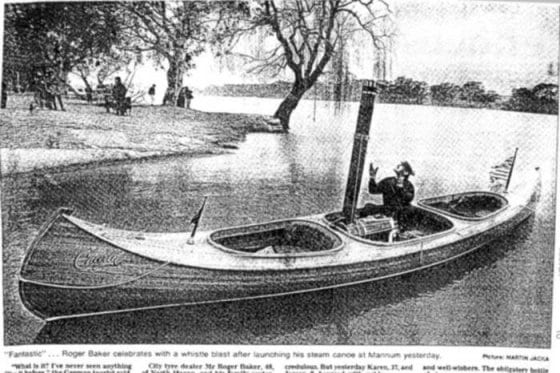
“What is it?” I’ve never seen anything like it before,” the German tourist said.
Standing in front of onlookers he – and everyone else – was bemused by the strange craft bobbing on the River Murray at Mannum.
(reprint from Messenger Press, Adelaide)
Building a DIY Edwardian steam canoe requires careful hull lofting but modified for Cedar Strip Construction. Few Australians have seen craft like the SC Charlie, a 24ft river launch based on traditional Thames designs from the 1890s to the 1930s. Hull design was by Storer Boat Plans, layout and everything else by the owner.
They were the result of what is called the “canoeing craze” that started in the mid to late 1800s in Europe.

City tyre dealer Mr Roger Baker, 48, of North Haven, and his family yesterday slipped SC Charlie from its specially-built trailer for its maiden voyage.
Charlie’s evolution began in 1993 as nothing more than Mr Baker’s dream. The keen yachtsman thought about building a yacht or motor launch, but he wanted to create something unique. His inspiration came with the chance discovery of a wooden boat calendar featuring an original canoe.
The more Mr Baker studied the small calendar photograph, the more the idea tantalised him. When he told his family they were incredulous. But yesterday Karen, 37, and James, 9, beamed with pride.
The project was never going to be simple and he had an immediate setback when the British Maritime Museum said plans for a steam canoe no longer existed. But a marine architect (Storer Boat Plans – not a marine architect) came to the rescue, computer-enhancing the photograph to produce the design.

(interesting byline, the above image by me, is used as the logo of a famous university design school in the UK. I spotted it and sent their head an email giving them permission to use it. They never replied :) )
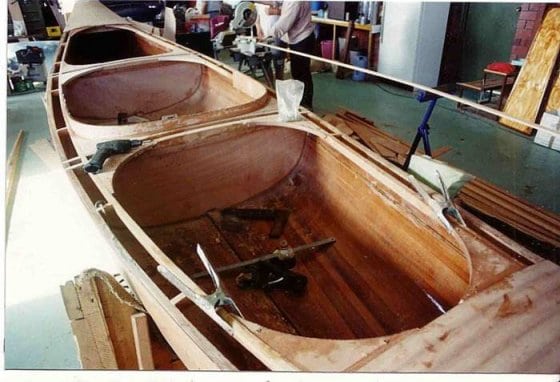
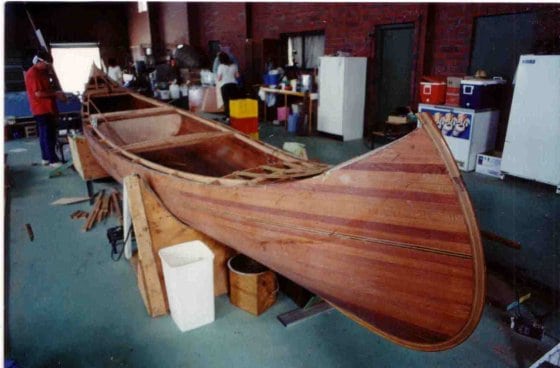
The cedar planked with American Oak trim hull gradually took shape, but not without the odd mishap. Early in the process the wood shrank during excessively hot weather, causing the hull to “implode” (actually curled up inwards as moisture was lost from the unsealed internal faces. It was resolved by spraying the interior with water, covering with tarpaulin and intense prayer – MIK).
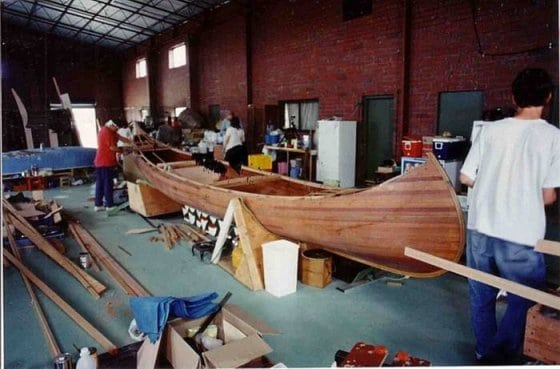
This photo is at Roger’s second Summer School after a year. First Summer school he built the hull. The school was run by Robert Ayliffe and David Wilson both of Duck Flat Wooden Boats in Adelaide. Robert now runs Stray Dog Boatworks.
Finally the exquisitely-finished, sleek 7.6m by 1.4m hull slipped into the Murray River to the applause of family and well-wishers. The obligatory bottle of champagne was poured rather than smashed over the upturned bow – for fear of damaging the woodwork.
“Fantastic, just unbelievably fantastic,” an excited Mr Baker roared as Charlie built up a head of steam.
“At that rate we’ll be able to waterski behind it … just kidding,” Mrs Baker said.
Only last week the hand-built “compound steam” engine, constructed by retired marine engineer Mr Dick Lambert, was fired up for the first time.
Charlie carries three people and will be used as a pleasure craft as well as be exhibited at boat and steam engine shows.
Details of the Edwardian Steam/Electric Canoe
- Length – 7.6m (24ft)
- Beam – 1.4m (4ft 8ins)
- Construction – Western Red Cedar Strip planking, American Oak trim
The price for the development of the Steam Canoe was around $600 for a hullshape – the temporary mold shapes are printed out full size) as well as a construction cross-section (which gives the sizing and location of the timber structure, fibreglass etc). This assumes, like Roger Baker you can work out the details for installing the engine, propeller shaft etc.
Of course it is also possible to fit a small inboard engine or electric motor and batteries.
Roger did later convert it to a low horsepower diesel installation. Steam is lovely for the first five years. All these years later perhaps electric would be the sweetest choice – and incidentally quite fitting as several original Edwardian canoes were electric powered
We don’t automatically take on any project of this type, but when the boat is something special and the builder is clear about what they want and know how to fill in the details we can get quite excited too!
Anchor text: Strip planking boat construction methods
