Video image can take a moment to load.
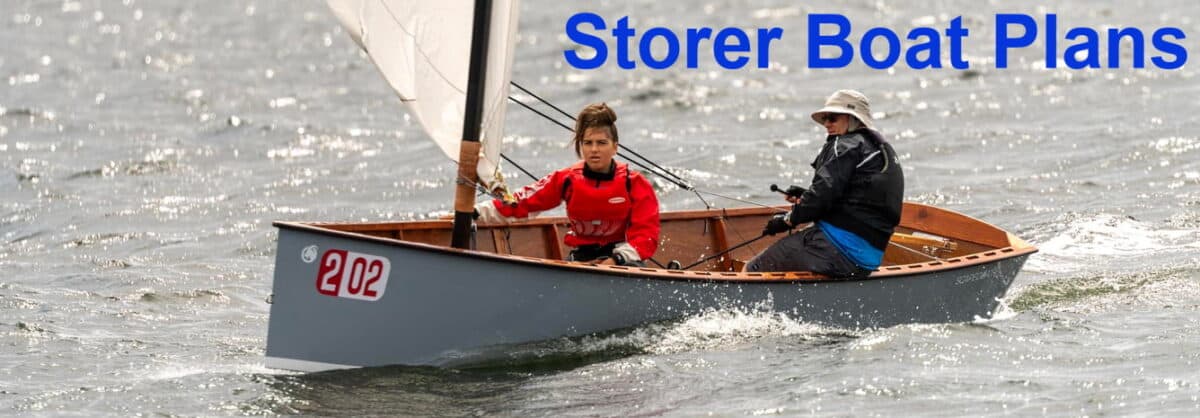
The Viola plywood Sailing Canoe plan has the characteristics of a performance sailing dinghy with the portability of a wooden canoe. We also have a great video. 75lb/34kg hull

Read Below for more Information or see our long list of articles about the Viola Sailing Canoe
Viola Details for Builders – Assembly and rigging information
Kits For Viola 14 Canoe
Europe – Viola 14 Sailing Canoe Precut Plywood and Timber Kits
Americas –Viola 14 Saling Canoe Precut Plywood and Timber Kits
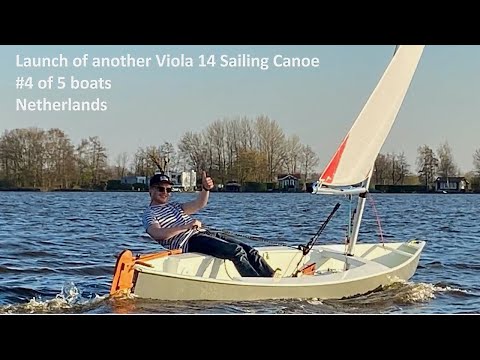
The simplicity and light weight of a sailing canoe with the hullshape and stability of a good sailing dinghy. Viola’s beam is 14ft (4.3m) long and 40 inches wide (1.0 metre) for stability. This is a little wider than most pure paddling canoes and the hullform itself provides even more stability. Below we have a video of a Viola 14 sailing standing up in the boat to raise the sail after going under a low bridge.
The hull comes out at a very rooftopable 34kg or 75lbs. Just a little heavier than an RS Aero and around half the weight of a Laser.
Note how the nose lifts nicely without the crew having to move aft.

Why a Sailing Canoe?
Our different sailing canoes have different mixes of sailing and paddling ability. Some use existing canoes and add the sailing function.
For an overview see our page about practical choices about performance, handling and advantages and disadvantages of different sailing canoe concepts.
Link – Four Sailing Canoes in Plywood and One Outrigger Canoe
Regatta and RAID Event performance

The Viola 14 Sailing Canoe has blitzed some long distance events 11th of 150 entrants.
11th out of 150 in major Netherlands Event
1 hour ahead of next boat in RAID event


More Videos below
Video image can take a moment to load.
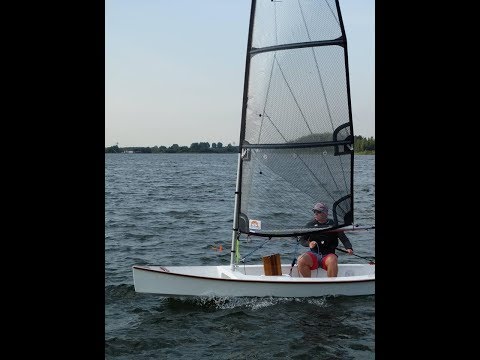
Joost’s Experience building and using the Viola for two years – Paddling, Camping, Sailing, RAID and distance events.
Part 1
Part 2
The simplicity and light weight of a sailing canoe with the hullshape and stability of a good sailing dinghy. Viola is 14ft (4.3m) long and 40 inches wide for stability.

The hull comes out at a very rooftopable 34kg or 75lbs. Just a little heavier than an RS Aero and around half the weight of a Laser.

The main market is the same as the RS Aero – people who want a fun dinghy with good manners, good performance and easy enough to get onto the water singlehanded.
Similar to our BETH Sailing Canoe which has modern performance even though it is has a traditional Yawl Rig. but the aim with Viola was for a cool minimal mainstream boat.

Simple plywood construction for the Viola Sailing Canoe
Everything that could be stripped out of the Sailing Canoe hull was – on paper and we resisted temptation to add more as we went. Very much the process with the now well known Goat Island Skiff. Nothing to remove, nothing to go wrong. A minimal light boat is often the fastest.

This lovely prototype of the Viola sailing canoe plan has been trialled by Joost Engelen and Viola Spek over the last two years.
It is built from four sheets of 4mm plywood. We recommend using gaboon to keep the weight down as far as possible to augment the portability.
Plans and Kits for Viola 14 Sailing Canoe
Most boats are built direct from the plans available from our Agents.
Kits are available in Europe and the Americas
UK and Europe – Viola 14 Sailing Canoe Precut Plywood and Timber Kits
Americas –Viola 14 Saling Canoe Precut Plywood and Timber Kits
First Sailing of the Viola 14 Sailing Canoe – 4.7sq m sail option
There are four sail options for the Viola Canoe – each of different dimensions. The laminate sails can also be made of conventional sailcloth.
- Lugsail at 6.3 square metres. Reefs and drops on the water.
- Laminate sail 4.7 square metres. Has one reef which needs to be done on shore.
- Laminate sail 5.4 sq metres. We developed this sail as the 6.0 sq metre laminate sail was too large for most sailors. One reef on shore. 6.0 is still available but not recommended for most.
This is one of the first videos after building the Viola.

Video image can take a moment to load.
Viola, Joost’s wife was a dinghy racer when young but has had a long break from competitive racing (apart from RAID events and fun sailing on the family Goat Island Skiff). She really likes how this boat handles and from the start, she has felt very confident to go out sailing in it. She has capsized the boat a few times and finds the recovery easy enough. In her own words, after the first sail,
What a fun and easy boat to sail!
Viola Spek after a 8 year gap from solo sailing

Spars in the Viola sailing canoe plan are simple cheap aluminium tubes to keep the cost down.
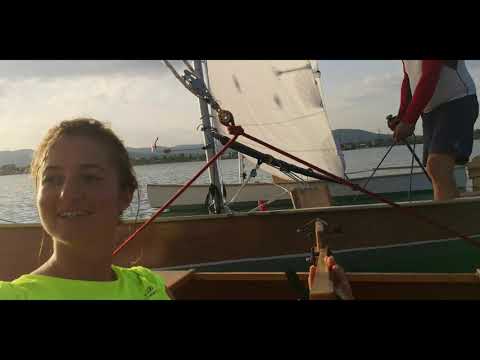
Video Two More Viola sailing canoes together in Hungary
Video image can take a moment to load.
Viola Sailing Canoe Rig Option 2 – Bigger Laminate Sail 6sq m
Back to the Netherlands:
Joost felt the boat was quick but perhaps too easy to sail for his body weight so we developed a bigger rig as an option. It uses the same bottom mast section as the smaller rig so gooseneck, vang and other expensive systems don’t need to be purchased twice.
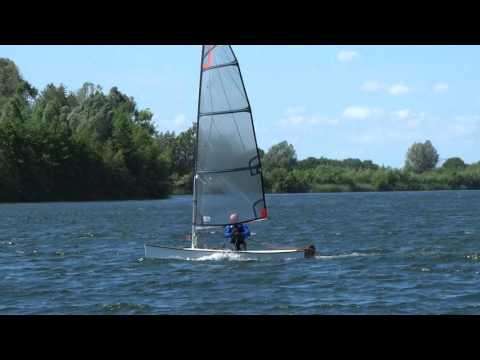
Video image can take a moment to load.
RAIDing in the Netherlands with the 6.3sq m balance lug on the Viola.
The surprise was to find an open sailing canoe that is more than capable in strong winds in a RAID format. This was with a larger balance lug. The balanced lug (a speciality of ours) allows more sail on the sailing dinghy/canoe with less heeling moment and dropping the rig is possible for going under bridges in the Netherlands or reefing for stronger winds.

Video image can take a moment to load.
Photos from the Dorestad RAID

Strong wind and rough water performance of the Viola Sailing Canoe in the Dorestad RAID – canoe vs sailing dinghy.
In last year’s Dorestad RAID event it blew strong on a couple of days. The Viola Sailing Canoe was out sailing when some of the other boats were deciding to continue or not.
When the speed comes on the bow lifts just a bit without the crew needing to move aft – a common setup in the best sailing dinghies.
Passed the 2 boats that were still in front of me and reached the lock we had to go through to find the first boat. The smallest 3 boats made it there first (2 twelve foot class boats and the Viola 14 canoe – not sure what that means though!).
Then some gentler sailing on some canals with one bridge to pass under the second reef (3.7m2). One reef would also have been manageable here. Then onto a lake with a horrible 50cm chop with strong winds (Bft. 5 maybe, reefed sail was just okay).

Deep reefed on one of the strong wind days. The yard and boom for the balance lug sail were recycled from a carbon windsurfer mast bought new. It was cut to get the right bend requirement for the canoe yard.

By far the smallest boat in the fleet, but one of the most capable.

Hull dynamics stop the bow of the sailing canoe from getting into trouble.
I was quite surprised at how nice it looks, but you can see from the videos how power builds and there is pressure on the boat the bow rises nicely keeping out of trouble. That was part of the thinking that we have worked on over the years and it is a substantive part of the process of developing the lines of this specific sailing canoe plan.
And it worked great here!

The Viola Sailing Canoe has good performance in light winds too
On the final light wind day
The third day was most enjoyable from a sailing perspective, tacking up some canals in a perfect constant upper Bft. 3 under full sail.
Started in last position but was well ahead of the fleet at the lunch stop. On the way back the boat sailed away from all other boats easily.
The last day there was very little wind. Here the low drag hull has an advantage even though it has a lot less sail area in comparison to the other boats.
Sailing on the Sea and Capsize with the Viola Sailing Canoe – the sailing dinghy stability pays off in another way

Floating the Viola has enough stability to allow Joost to stand up to raise and lower the sail and mast with no trouble.
Joost has sailed it on the sea in rough conditions a couple of times. He recommends a self-bailer for such conditions but finds steering, balance and predictability good.
Righting from capsize is easy for either Joost or Viola. The trick is not to rush the boat. The harder you press down on the centreboard, the more water will be inside the boat when it is up again.
Gentle raising keeps the water down to a bucket worth and boat has good stability and can sail with no problem.
Good Sailing Dinghy Performance with Sailing Canoe ease of handling off the water.
Joost’s articles are here –
Viola 14– Part One
Viola 14 – Part Two
Kits For Viola 14 Canoe
Europe – Viola 14 Sailing Canoe Precut Plywood and Timber Kits
Americas –Viola 14 Saling Canoe Precut Plywood and Timber Kits
Several Canoes? Then you need a triple storage rack to build yourself
Estimado Sr.:
Me encantó su velero, lo felicito.
No dispongo del dinero como para comprar el plano, pero Ud. me podrá orientar respecto de alguna opción como para poder adquirir dicho plano.
Nuevamente lo felicito.
Lo saludo respetuosamente.
Javier Gómez (Argentina. Mendoza)
Hola Javier, (google translate)
Hay algún costo en el plan. También hay un costo en materiales para hacer el bote y comprar una vela. No tengo una solución para tu problema. Estoy diseñando una canoa para navegar y remar. Será más barato que la viola, así que consulte la página principal de mi sitio web. Pondré el nuevo diseño en dos semanas.
Saludos
Michael
Original.
There is some cost in the plan. There is also a cost in materials to make the boat and purchase a sail. I do not have a solution for your problem. I am designing a canoe for sailing and paddling. It will be cheaper than the viola so check the front page of my website. I will be putting the new design up in two weeks.
Thank you Michael !
Well, I’m going to go ahead with the build this either way …
Maybe by next spring I’ll have enough $$ to dive into the rig you have specified ..
Is all of the information about building the mast and boom, and anything else associated with the sail rig contained in the plans you provide?
What would you estimate the overall cost to be for building the whole thing (i guess not including the sail, because I realize that’s third party ..)
Oh, have you ever taken out into the ocean, or large bays? I’d be sailing up in Narragansett Bay, RI, and Long Island Sound in NY primarily, although hoping to try some lakes up north too
…just one more thing .. What do you think about this being able to handle me (about 180 lbs,) and a small boy about 30-40 lbs ?.too small?
Is there a forum where people have posted their builds and experiences?
Hi NP,
The weight of yourself and even a larger child will be fine. I didn’t really draw the boat to one “average” adult, but an adult and a half. So an adult and small child will be OK. Two small kids for messing around in a bay.
Joost has taken the boat out in both rough sea and rough lake conditions. Has sailed fine but recommends a self bailer.
He did also capsize and was able to recover on the sea. Before he fitte the bailer.
Cost – maybe 2500 in most developed economies for quality materials. For the lug rig. More for the dinghy rigs because of the amount of additional rigging.
Drop into the facebook group.
https://www.facebook.com/groups/storerboatplans/
MIK
Hi !
This design is exactly what I’ve been searching for! .. The size and weight of this hull is perfect for my needs in terms of cartopping, storage and single handing..
I’ve got a question about a rig ..
I have a Laser Radial rig that seems like it would fit this boat well, in terms of sq footage and overall size .. I notice on your ‘Violas Dancing’ video one of them seems to have a triangular dinghy sail much like a laser radial ..I’m wondering what you think about using the this Laser Radial sail on the Viola 14 ? (This is a cost issue for me at this point as well, realizing that the prescribed fathead sail design you specify is likely more optimal, and maybe an upgrade option for me down the line)
Really looking forward to building this either way!!
Thanks!
Howdy,
I checked the centres of efforts. The Laser Radial main centre of effort will be around 100mm behind the Viola sail. So there will be some weather helm. This is not necessarily a deal breaker as I design boats to be very neutral helm – so some extra weather helm will PROBABLY not matter too much.
OK there is enough depth in the Laser mast to allow the vang fitting to be above the deck level. So that is OK
However there are a couple of things to be overcome.
1/ Mast Diameter. Laser is 65. Viola’s mast is 60 so the rig will be heavier making the boat less stable when moving slow or running. Wind pressure is your friend if you are used to skinny boats. At a certain heel angle or rapid heeling the mast may feel that it has taken over and proceed to the horizontal despite corrective action :)
2/ You personally still have the same weight for the taller Laser rig (taller than the Viola rig) – so will have to hold up the Radial rig on a much narrower boat. This might limit the strength of breezes you can go out in unless very comfortable sailing skinny boats.
Some useful discussion from Joost about general handling of Viola for him and his wife Viola (sailing individually). In particular about capsizing and righting.
Both can manage it though Viola has only sailed very occasionally in the last 20 years …. (Joost’s text below)
if you are okay sailing a Laser, you will be fine sailing the Viola 14 canoe. Obviously it is a sporty boat and I capsized 3 times in many outings: once because I simply lost my footing during a gybe and twice in strong winds of Bft 5-6 and very confused seas during a tack (body weight on one side already with the bow suddenly thrown back by a wave).
The last couple of years I have mainly been sailing the Goat Island Skiff (much larger and heavier) and a couple of times our Chickadee scow (smaller in length, but similar in the sense of being a light sporty and fast boat). I immediately felt at “home” in sailing the boat and it did not take long getting the boat completely dialed in really. Viola (my partner) also felt very confident from the start sailing the boat. Viola has sailed Lasers when she was a teenager, but that was 20 years or so ago. It is very stable for the width due to the asymmetrical hull shape with its flat sections aft.
The smaller fathead sail is very manageable and so is the lug sail (this sail is quite a bit larger, but the centre of effort is low). The large fathead sail is more difficult to sail (longer mast, more weight aloft and higher centre of effort).
For lighter persons up to 75-80kg or so, especially when also sailing in stronger winds, the smaller fathead sail I would consider the best option (there is also a one reef in it). Obviously the larger sail provides more power and is a blast to sail if you can handle it. You will need better skills and need to be a heavier sailor though (Viola feels completely overpowered by the rig and the confidence she has sailing with the smaller sail is not there at all when sailing the big rig).
If wanting a more flexible rig in use (ease of reefing, getting the mast down, etc.), the lug rig is a good option.