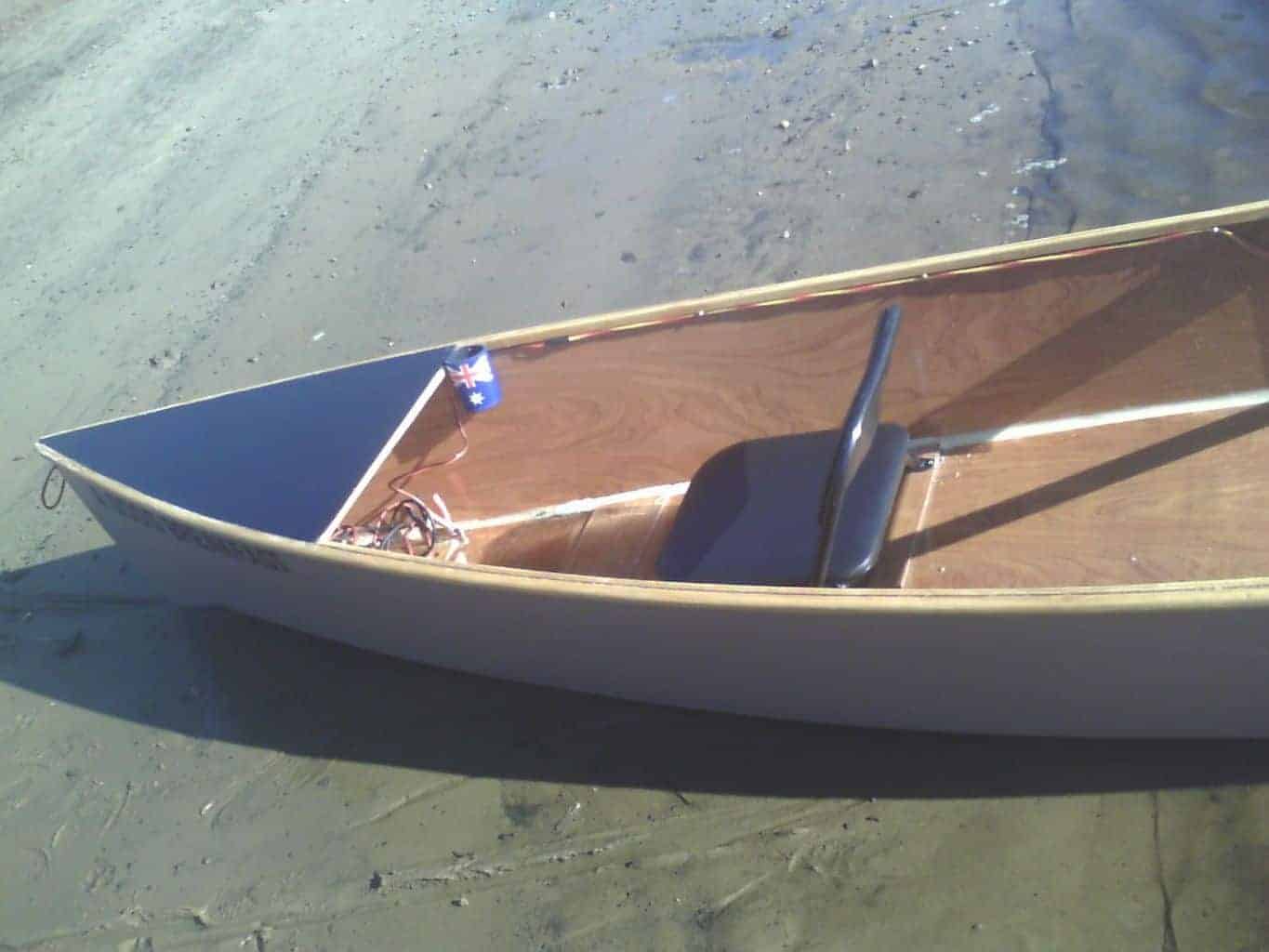
Peter Caspari and his Electric Quick Canoe – square backed canoe.
The Quick Canoe Electric is a simple to build cartoppable square back canoe.
It can be quickly and simply built in plywood.
Peter Caspari’s boat is shown here.
The Quick Canoe Electric is a simple to build cartoppable square back canoe.
It can be quickly and simply built in plywood.
Peter Caspari’s boat is shown here.

The rudderbox design I use has distinct advantages over normal swinging rudder setups. Once you try this design you will never be satisfied with a swinging blade again. But some of the details are important!

In the late 70s as a sailing teenager I drew boats on every available paper surface.
A new book “a lighter ton” describes the exciting development of racing yachts to create newer, lighter, faster and cheaper and FUNNER boats.
Many of the developments were from New Zealand designers such as Bruce Farr, Paul Whiting and Laurie Davidson. A new book by Richard Blakey covers this exciting experimental period in yacht design

This is an article about how bias in thinking produces weird results in terms of boat designs.
I compare a silly boat design trend of 100 years ago with modern canting keel maxi yachts.
Personally I don’t think they should be allowed to use engines to run the keels and the various systems – if they do then they should be disqualified from the event results. The conventional human powered boats should be listed as the winners of events.

The above photo was taken on the third day of our Canoeing trip on the Loire River in France. The two black canoes didn’t even exist a week ago.
When I wrote the original article on Disposable Canoeing I had no idea at all what it would lead to me and a bunch of adventurers, wine and cheese connoisseurs. Most of us didn’t even know each other! The picture above is the result of this adventurism, but what happened to make it happen?
What technology was involved to make the boats faster to build than most stitch and glue boats and what weather conditions did we have to overcome to make it all happen.
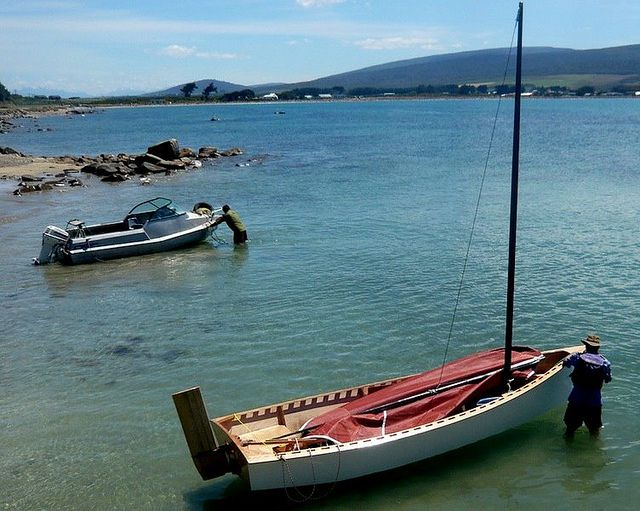
The first New Zealand Goat Island Skiff has been launched by Ian Howeth.
He has taken a year to build it as spare time became available.
It was launched during the Xmas break

Golfballs go further because of those dimples on the surface. Would it make sense to have those dimples on a boat hull?
It is not quite that simple as this little article attempts to explain.

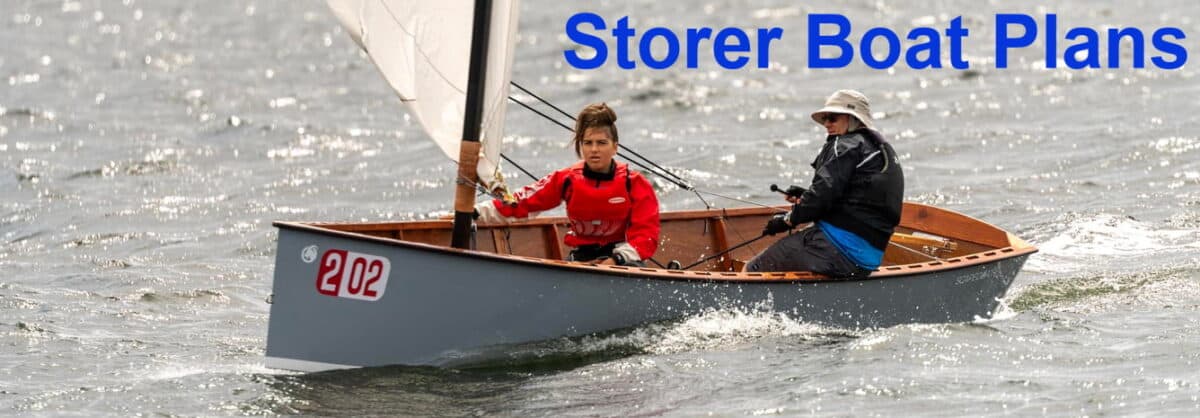
John Goodman and I sailed the immaculate Goat Island Skiff he built from my plan in the Texas 200.
The boat showed itself to be one of the faster in the fleet despite loading up such a short boat with food, water and camping gear for six days with little outside support.
We played with sailing the boat by the lee – a method used by racing boats to gain both speed and control.
I document the method here including a video showing how the angle of heel can be controlled using the mainsheet.

AlexN, who is building an Oz Racer and I drove up to Toronto at Lake Macquarie for the Classic Boatfest 2011. I think I will go again in 2012 and try to have a boat to sail around.
Shows on the water are the nicest type and this one has good access for small sailing boats and canoes.
We met up with Bruce (Woodeneye on the storerboats forum) who had is “for sale” Goat Island Skiff.

How much fibreglass is really necessary to prevent damage to a plywood boat for most users?
For a long time I’ve been suspicious that both designers and builders are in a never ending spiral of more and more heavier fibreglass.
I argue, with data from the Turner designed Jarcat, that the weights of glass are clearly excessive for most uses and users of small boats.

Csaba is my agent in Hungary.
He has translated several of my plans to Hungarian.
This is some of his promotional material in Hungarian.

Jack is rather happy with his newly launched Eureka Canoe.
He has built it as a woodworking project over the last couple of years as time became available from his busy architectural practice.
Anyway … a bunch of nice photos and some of Jack’s writing.

More videos of John Goodman’s Yawl Rigged Goat Island Skiff.
He is trying out some rigging variations to see if we can simplify the building of the yawl rig version.
At the moment this is inconclusive, but wow, he got some good videos

The TEXAS 200 sailing event is on again. A 200 mile sail and camping trip up the Texas coast that runs every year.
I am going to be in town, so would be crazy not to attend. This is a call for all interested storerboats to consider attending.

Michael Storer will be attending the 2011 Woodenboat Show in Mystic Seaport. He will be running a workshop for families building the Quick Canoe – choice of either the electric or the paddling versions along with Duckworks and J.O. Woodworking.

Photos and slideshow from the Goolwa Wooden Boatshow 2011.
Over 250 boats – mostly in the water. Wooden hydroplanes, “restricted 21s”, riverboats, putt putt launches, classic sailing boats, kayaks, canoes and more.
I had the quick canoe, the eureka canoe and the OzRacer on the stand that was shared with Duck Flat Wooden Boats and Boatcraft Pacific. Good time was had by all.

Dete Hasse and his family built a Goat Island Skiff in Geelong, Victoria a while ago. He has just written to me about his experiences trying to sail on Port Phillip Bay and more happily on the recently refilled (the drought is over!) Lake Eppalock.
Also he makes some good comments about reefing and how it changes an overpowered boat into a much more rriendly beast in stronger winds.

The Goolwa Wooden Boat show is on the coming weekend.
Storer Boat Plans and Duckflat are having a joint stand as per normal.
The show itself is free this year with 250 boats entered in events or on display.
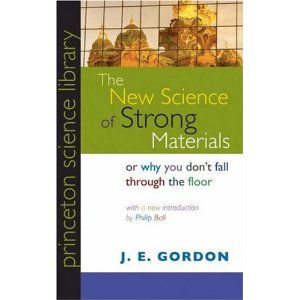
One of the most important things as a designer or sailor is to keep an open mind, but also to be able to analyze things in light of real experience and prior knowledge. These are online and paper resources that force thinking in different ways.
This article, after a bit of a spiel, goes on to give some great resources that “opened my eyes” at different times in my life.
They focus on areas of structural design, sailing, sail aerodynamics and touch on a bit more.
