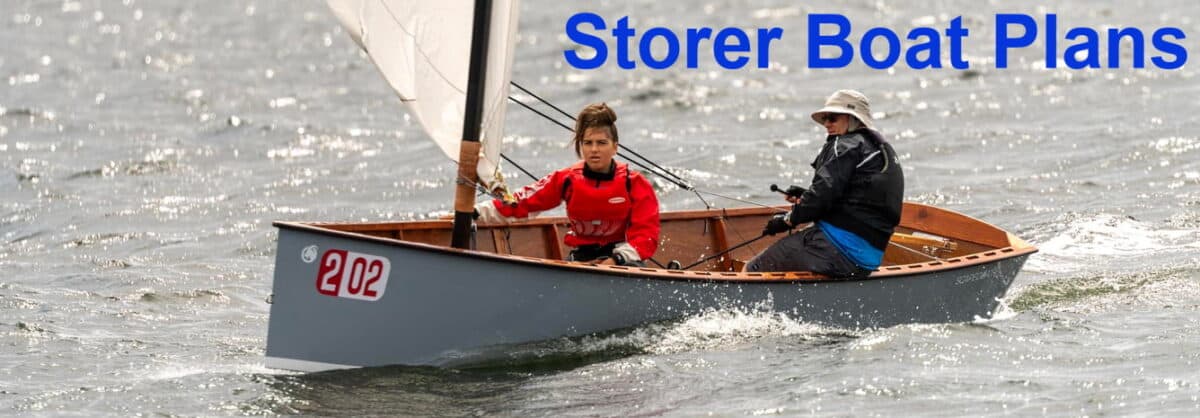
France’s premier traditional wooden boat magazine, Le Chasse-Marée, features a major editorial and review praising the simplicity and performance of the Goat Island Skiff article. Below is an English translation of their editorial on lightweight, efficient boat design.
I have translated the editorial into English as much as I dare – below.
Article Outline of the Goat Island Skiff
I knew the article was on the way and there were photos of the Goat Island Skiffs in France and the Netherlands. I’m not quite sure if I like the bowsprits for flying a light weather jib, but the owners are happy with the arrangement. The light wind performance of the goat is already excellent.
But the enthusiasm and excitement of the GIS builders comes through in both the article and the editorial (below)

Translation of the Editorial from Le Chasse-Marée – Praise for simple effective boats.

In Praise of Making it Simple
Translation (Approximate):
MAKE SIMPLE
“The Goat Island Skiff is a study in raw simplicity,” writes Emmanuel Conrath in his review (see page 76). Yet this boat has completely won over its builder.
(The full article on page 76 is available in French here and in translation below “Goat Island Skiff: The Planing Sail-and-Oar Dinghy“)
Once his article was put to bed, Emmanuel set off for a sail-and-oar weekend in the Gulf of Morbihan. Upon his return, he was jubilant: “Doublehanded, we carried full sail in 15 to 25 knots of wind, effortlessly planing at 15 knots on broad reaches through big chop.”
The Goat Island Skiff, like Jean-David Benamou’s catamaran (CM 307) or Gilles Montaubin’s dinghies (CM 188), is part of a revival in the sail-and-oar movement—a class of boats too long confined to heavy, overly traditional craft that failed to realize the true potential of the concept.
In this vein, we are seeing more and more custom one-offs and original designs that reflect a growing enthusiasm for lightweight dinghy cruising. Ideas are flourishing and new projects appear almost daily, particularly on social media. That is excellent news.
Yet looking more closely, one often finds “clever ideas” that lead to flawed designs: hulls too narrow or with too little freeboard for open water; boats lacking enough form stability—or even initial stability—for stress-free sailing; and over-divided, complex rigs that make a skipper dread having to reef or strike sail.
Too often, attempting to fix one flaw creates another: adding outriggers to an ill-proportioned hull, or installing water ballast. In this downward spiral, lightness is sacrificed to weight and clutter—the natural enemies of both performance and simple enjoyment.
It is often said that the smaller a boat is, the harder it is to design. Simplicity and efficiency are hard-won through deep thought and extensive time on the water. As Emmanuel Conrath concluded: “Whether looking at plans from Michael Storer or John Harris, it seems the designer has scrutinized every single component, stripping away the superfluous and continually redrawing to simplify even further.”
■ Gwendal Jaffry
English Translation of the Main Chasse Maree article about the Goat Island Skiff
Goat Island Skiff: The Planing Sail-and-Oar Dinghy
By Emmanuel Conrath
The Goat Island Skiff was one of the revelations of the 2019 Challenge Naviguer Léger (CM 307): elegant despite its raw simplicity, easy to handle, fast, and comfortable. Emmanuel Conrath, its builder, reflects on this Michael Storer design and the modifications he made before sharing his first impressions underway.
Introduction
In 2014, when I first discovered the Goat Island Skiff, I nearly fell off my chair. What? This rough-hewn, angular lugger-type skiff was supposed to be able to plane?
A few online videos and a browse through the website of its designer, Michael Storer, convinced me of the genuine merits of this classically styled design, which boasts performance on par with a Laser.
At first glance, the Goat Island Skiff (commonly known by its acronym GIS, named after an island in Sydney Harbour) appears brutally simple: one bottom panel, two side panels, a plumb stem, and a slightly raked transom. As for the interior, it is limited to two watertight buoyancy compartments at the ends, a midship thwart, and of course, the daggerboard trunk.
However, that initial impression quickly changes on closer inspection. Through fair curves, subtle rake angles, and balanced proportions, Michael Storer succeeded in designing an elegant boat despite its extreme simplicity.
(Caption: Let’s Goat, the GIS built by the author—seen here at the helm—has been sailing since last March. Note the soft textile strops for the mainsheet and downhaul on the boom, which avoid weakening the spar with through-holes, as well as the bowsprit for the asymmetric spinnaker lashed to the stem.)

Specifications & Hull Design
- Length Overall (LOA): 4.73 m (15 ft 6 in)
- Beam: 1.52 m (5 ft 0 in)
- Depth: 0.58 m (1 ft 11 in)
- Hull Weight: ~60 kg (132 lbs)
- Payload: 300 kg (661 lbs)
- Sail Area: 9.75 m² (105 sq ft)
The GIS measures 4.73 m long by 1.52 m wide and weighs only around 60 kg—the maximum load Michael Storer considers practical for two people to carry over short distances. Beyond the minimalist interior layout, this featherweight displacement comes from its build: almost entirely 6 mm Okoume marine plywood over chine logs and a substantial sheer clamp. Fiberglass cloth is restricted to reinforcing tapes over the exterior seams and chines.
The waterlines forward are fine, while the widest section of the flat bottom (1.02 m bottom width vs. 1.52 m maximum beam at the sheer, showing considerable side flare) is located well aft, at roughly 70% of the waterline length. These characteristics allow the hull to plane early; conversely, the narrow waterline beam is a major asset under oars.
The GIS omits a skeg to minimize wetted surface. Choosing a daggerboard keeps construction simple and saves weight. In the same vein, the rudder is a straight-profile blade held between cheek blocks by shock cords. The designer points out that this allows the rudder blade to kick up in a grounding—provided the daggerboard hasn’t broken first! (editor – I don’t think one has ever broken despite many hundreds sailed hard).
Though simple, the appendages are refined: to ensure optimal lift with minimal drag, Storer specifies precise NACA symmetrical foil profiles for both blades.
Sidebar: Michael Storer, Naval Architect
In his youth in Australia, Michael Storer raced extensively, notably in the NS14 development class dinghies—an experience that strongly influenced his design philosophy. After stepping away from formal naval architecture studies (he could not see himself designing container ships for life), he joined Duck Flat Wooden Boats, then Australia’s largest supplier of small-craft plans and kits. There, he realized one could easily build fast boats with traditional appeal for a fraction of the cost of contemporary racing dinghies. During this period, he also encountered the designs of Iain Oughtred, appreciating their clean simplicity and builders’ documentation.
For Storer, building a boat should take weeks, not months. Plywood combined with epoxy resin became his medium of choice, eliminating most heavy structural framing while reducing parts count, weight, and cost.
His Beth sailing canoe (1989) was an early success. The GIS followed in 1992 and remains his personal favorite, with over 138 hulls built worldwide. Storer now resides in the Philippines, promoting grassroots racing with his flat-bottom OZ Goose dinghies, providing plans, sails via Really Simple Sails, and extensive technical articles online.
A Balance Lug Rig with Remarkable Performance
With Storer’s Australian racing background, the GIS carries a generous sail-area-to-displacement ratio with 9.75 m² of canvas. The boat sets a boomed balance lug—a configuration Storer champions across almost all his designs.
Michael explains that he learned much of what he knows about balance lugs from Beth:
“Modern sailors often overlook the balance lug because they assume it is complicated and obsolete. Because they don’t know how to set it up properly, many get mediocre performance, and designers ignore it out of unfamiliarity. Yet the balance lug is exceptionally efficient upwind and powerful downwind, with a very low center of effort.”
He addresses the myth of the “bad tack”:
“People often assume sail distortion when the sail rests against the mast on the ‘bad tack’ destroys efficiency. Yet in one-design OZ Goose racing in the Philippines, we observed negligible performance differences between tacks—sometimes the boat even pointed higher with the sail against the spar.”
Spar Dynamics & Rig Tuning
Storer’s key rigging principles include:
- Mast Rigidity vs. Spar Flex: The unstayed mast must be stiff to maintain luff and halyard tension without bagging out the sail. Conversely, the yard and boom must be flexible (around 50 mm diameter on the GIS) to bend under gusts, opening the leach and allowing the head of the sail to twist off automatically.
- Halyard & Downhaul Tension: Setting the lug properly requires high halyard and downhaul tension using low-stretch line. If a diagonal crease develops from the throat to the clew, the downhaul must be hauled tighter. In strong winds, maximum downhaul flattens the draft completely.
- Boom Downhaul Attachment: The downhaul must attach to the boom directly adjacent to the mast pivot. Off the wind, this prevents the boom and clew from cocking skyward, controlling leech twist and retaining effective sail area—unlike loose-footed lugs.
- Hardware Attachment: Storer advises against wood screws on spars, which create stress concentrations. Instead, rope strops around the spars take the loads, restrained from sliding by simple saddles/fairleads. Snap shackles on the lower downhaul and sheet blocks allow rapid strike-down of the rig.
