
Do Golfball Dimples Make Boats Faster?
Golfballs go further because of those dimples on the surface. Would it make sense to have those dimples on a boat hull?
It is not quite that simple as this little article attempts to explain.
 Articles discussing my thoughts on sources for boat design information for performance, structures or boat handling – with a bias towards repeatable information.
It could be from competitive sailing or through interpretation of careful testing by others including my design peers. It all ends up applying to my boat plans
In the end … if it doesn’t appear on the racecourse somewhere … it probably doesn’t work.
This may be an overstatement, I have a soft spot for those who work through several versions of an idea over time.
 Don’t forget that the search function can help you locate information you are looking for. And don’t forget our search function – Top left on desktop. Or Mobile – tap menu on mobile and type in top line of menu.
Golfballs go further because of those dimples on the surface. Would it make sense to have those dimples on a boat hull?
It is not quite that simple as this little article attempts to explain.

John Goodman and I sailed the immaculate Goat Island Skiff he built from my plan in the Texas 200.
The boat showed itself to be one of the faster in the fleet despite loading up such a short boat with food, water and camping gear for six days with little outside support.
We played with sailing the boat by the lee – a method used by racing boats to gain both speed and control.
I document the method here including a video showing how the angle of heel can be controlled using the mainsheet.

How much fibreglass is really necessary to prevent damage to a plywood boat for most users?
For a long time I’ve been suspicious that both designers and builders are in a never ending spiral of more and more heavier fibreglass.
I argue, with data from the Turner designed Jarcat, that the weights of glass are clearly excessive for most uses and users of small boats.

Dete Hasse and his family built a Goat Island Skiff in Geelong, Victoria a while ago. He has just written to me about his experiences trying to sail on Port Phillip Bay and more happily on the recently refilled (the drought is over!) Lake Eppalock.
Also he makes some good comments about reefing and how it changes an overpowered boat into a much more rriendly beast in stronger winds.
One of the most important things as a designer or sailor is to keep an open mind, but also to be able to analyze things in light of real experience and prior knowledge. These are online and paper resources that force thinking in different ways.
This article, after a bit of a spiel, goes on to give some great resources that “opened my eyes” at different times in my life.
They focus on areas of structural design, sailing, sail aerodynamics and touch on a bit more.

There are lots of tips for building and designing boats on the net.
“Rules of thumb” are often quoted to help with the calculation of how much sail or how much keel or centreboard area or how big a mast is allowed to be and many other areas. Can a boat be stretched or shrunk or lengthened?
But how correct are they? Are they the best guide?
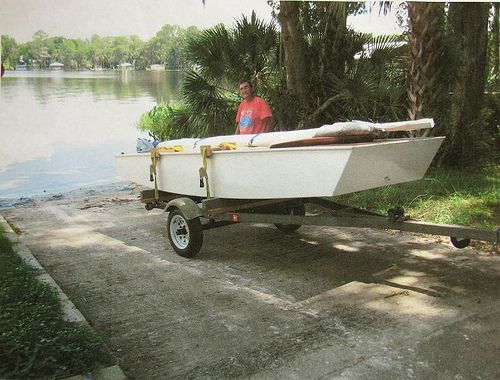
First detailed sailing report of the Goose 12ft sailboat.
The Oz Goose is a 12ft sailboat derived from the smaller OzRacer/PDRacer/Brick line. It uses all the same running gear as the OzRacer.

A video of the Quick Canoe in action.
My Agent in Hungary who sells plans in both English and Hungarian has launched the first Quick Canoe in those parts. It is designed as a very simple and easy to build boat. It is not a perfect high performance boat, but the numbers have been worked out to give good performance despite the simple shape. It won’t be as good as the best fibreglass canoe, but it will be better than many average ones. And much cheaper and lighter.

The conservative viewpoint is that traditional rigs are not very efficient. However allied to efficient hulls and set up correctly, lug and sprit rigs can be very efficient indeed – not too much slower than “modern” rigs, particularly when the same lessons are applied to trad sails and way cheaper.
This is a WIKI drawn from the group on the Storerboats forum discussions on setting up lug and sprit rigs for best performance building on the information in my webpage.
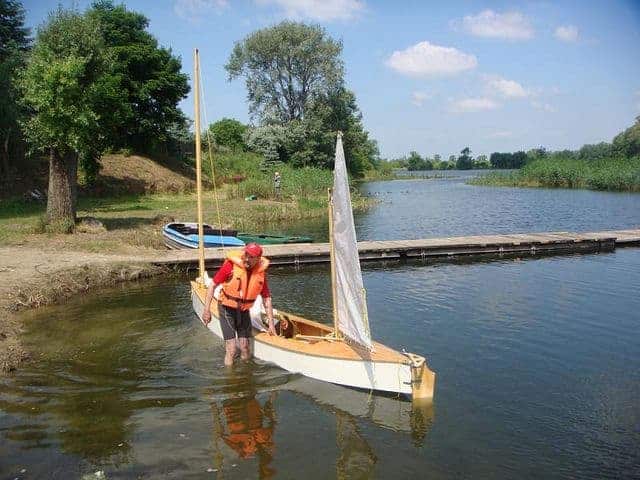
Robert Hoffman has been busy using his BETH sailing canoe that he built over a cold Polish winter.
There are now videos. I have also linked to all my videos on youtube – so you can see many storerboats sailing.

Reprint of an article I wrote a few years ago for Watercraft magazine in the UK.
The article points out why I think most of the discussion about boat design being a “compromise” is rubbish and taking that point of view means that the design is sure to be compromised.
What happens if we don’t accept the compromise?
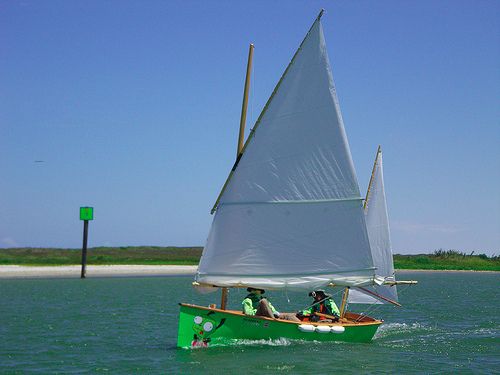
John Goodman who recently spent 5 days semi racing a Goat Island Skiff in the Texas200 event got back to me with some observations and even some pictures of aspects of the boat and the sailing.
I have responded with suggestions to make some further improvements. Between John and me there are some useful tips about setting up a boat for more speed.
However the standard setup of the Goat is fine for most – it is still pretty quick in standard form.
There is advice for both lug and sprit traditional rigs here.

Sailing the Goat Island Skiff in the Texas 200 for the first time. The Goodman family boat is now a regular in this 200 mile quite difficult sailing event in often extreme conditions.

This page compares the two plywood canoes in my range. Both have detailed plans and are simple to build.
The page is to explain the differences and to help potential builders see if one of the boats suits their needs.
Lots of links to pictures, build articles and even videos.
The cla

Exciting News, John and David Goodman finished the Texas200 event in their lime green Goat Island skiff.
Five days and 200 miles up the Texas coast dodging huge barges and commercial traffic.
They had a great time and are very happy with the performance of the Goat

Cliff and PJ live in Warm Queensland and Wintry Tasmania. However they both like to go the the yearly (June) wooden boat festival in tropical Far North Queensland.
This year they decided to build one of my Quick Canoes. They started on Saturday and finished including putting the canoe on the car roof by the following thursday.
They are experienced woodworkers so added some very nice details.

Perttu took his recently built “Quick Canoe” on a trip down a river in Finland.
We don’t have rivers like this in Australia! To see them is quite exciting.
The Quick Canoe is designed to be very cheap and easy to build, but still work OK.

Finally after many years of selling the plan I have a photo of a boat with the outriggers from the drop-in outrigger plan.
Every part of the outrigger is very light. The first one we built had each component under 10lbs.
It can make a canoe or kayak into a killer sailing boat. Or can convert a canoe, kayak or suitable dinghy into a stable fishing or diving platform for paddle or outboard.

Perttu is building his Quick Canoe in almost impossible conditions.
The middle of the Finnish Winter.
But the boat is going together well. He is building it very cheaply out of ply and polyester resin.

Fast building was part of the aim of this plan! Also to keep the expense down. Rick surprised me – I was thinking it would take a couple of weekends. The Quick canoe is very simple to build and comes out of three plywood sheets. A very simple plywood canoe It has been designed to be as easy to build as possible while keeping some of the qualities of a good paddling canoe – in particular the ability to track.