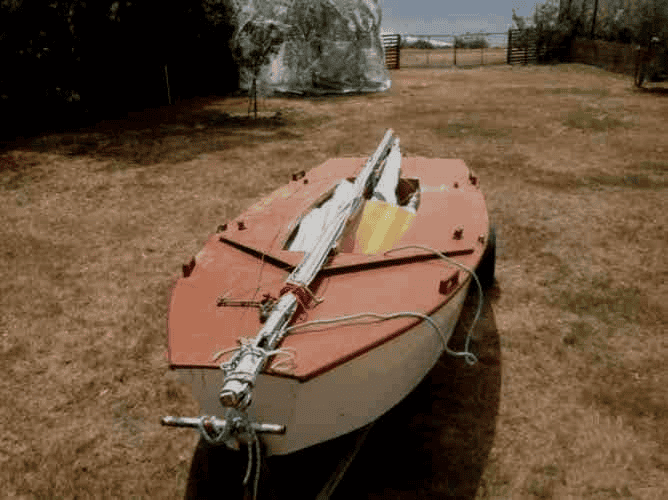
Q and A. Step 1 – Do I restore an old cheap racing boat or ditch it? International Cadet
When is it worth fixing an old racing dinghy and when is it best to ditch it?
When is it worth fixing an old racing dinghy and when is it best to ditch it?

All the best material on boat repairs. From restoring old sailing dinghies for racing, fixing holes in canoe, replacing whole hull panels or the neatest and easiest way of doing a really nice texture of nonskid using sugar. And the non skid can be done in paint or varnish

Most epoxy mixes are 2 to one resin and hardener. Or 4 or 5 or 6 to 1. Some companies offer 1:1 and push ease of mixing. But are they a good choice?

I specify butt straps because they are simpler, faster and have a neat result for amateurs every time. But I do place them in the hull where they won’t affect curvature of the ply. What are their advantages for joining ply compared scarf joints.

Opinions about capsize and recovery are worthless. “Safe Boats” do no exist unless the crew practices capsize. We cover the design points.

Sailing lessons 1 1/2 hours south of Manila on beautiful, natural Taal Lake. Boats, SUP boards and instruction, food, accommodation and Volcano and Eco Knowledge tours.

I’ve been in and around wooden race and recreational boats for a few decades now. As a designer who sells plans I can really only direct people towards the most tried and true methods that work just about anywhere. This article explains a large part of experience that leads to my approach.

How to reef a Balance Lugsail. A neat trick of using shock cord (bungee) for the intermediate ties makes it much faster to tie in a reef as well as remove the reef after. it also minimises the risk of damaging the sail if something major breaks elsewhere.
So how does a lug rig boat go in club racing? My designs won’t be outclassed in club racing. I’m really keen to find out how the yardstick (handicap) changes as George and crew get used to the realities of course racing making the boat sail faster. We end up with an estimate of PY – Portsmouth Yardstick for the Goat Island Skiff.

In general I don’t like most sailing books and most sailing lessons.
I think that a learner doesn’t need to learn many new words. Also because they don’t explain the correct principles in the beginning their explanations become really complicated.
If you understand how to use a sail to get power – when it is at maximum power and when it isn’t it all becomes very logical.

The above photo was taken on the third day of our Canoeing trip on the Loire River in France. The two black canoes didn’t even exist a week ago.
When I wrote the original article on Disposable Canoeing I had no idea at all what it would lead to me and a bunch of adventurers, wine and cheese connoisseurs. Most of us didn’t even know each other! The picture above is the result of this adventurism, but what happened to make it happen?
What technology was involved to make the boats faster to build than most stitch and glue boats and what weather conditions did we have to overcome to make it all happen.

Golfballs go further because of those dimples on the surface. Would it make sense to have those dimples on a boat hull?
It is not quite that simple as this little article attempts to explain.

John Goodman and I sailed the immaculate Goat Island Skiff he built from my plan in the Texas 200.
The boat showed itself to be one of the faster in the fleet despite loading up such a short boat with food, water and camping gear for six days with little outside support.
We played with sailing the boat by the lee – a method used by racing boats to gain both speed and control.
I document the method here including a video showing how the angle of heel can be controlled using the mainsheet.

How much fibreglass is really necessary to prevent damage to a plywood boat for most users?
For a long time I’ve been suspicious that both designers and builders are in a never ending spiral of more and more heavier fibreglass.
I argue, with data from the Turner designed Jarcat, that the weights of glass are clearly excessive for most uses and users of small boats.

One of the most important things as a designer or sailor is to keep an open mind, but also to be able to analyze things in light of real experience and prior knowledge. These are online and paper resources that force thinking in different ways.
This article, after a bit of a spiel, goes on to give some great resources that “opened my eyes” at different times in my life.
They focus on areas of structural design, sailing, sail aerodynamics and touch on a bit more.

I built the Quick Canoe in a day and a half. This is way slower than some of my customers.
It is the first time I have been disappointed building a complete boat this quick.
The risk of high expectations!
But a day and a half with the problems I had is pretty good.

Is it revolutionary?
The Quick Canoe uses Duct tape to hold the plywood together while the glue or glass tape sets up. This can save a huge amount of time.
The Quick Canoe is designed to take maximum advantage from the method.

Slideshow and pictures resources to show some of the methods for building the Eureka Stitch and Glue Plywood Canoe.

Melanie in the UK wrote to me. She has just bought an old Mirror dinghy and started sailing for the first time.
Problem is that the boat leaks and she doesn’t want to stop using the boat until the end of the season.
I have a philosophy of keeping older boats on the water and not pulling them off for months on end until you have the time to do the job.
So the article here is useful to see what can be done with an old leaky plywood sailing dinghy to keep it going.
It is perfect sailing weather at the moment in the UK and it is better she is out there learning but with the worst of the leaks gone.
With a disciplined approach she should be able to get all of this done in a week or so. The general leaks fixed permanently and the rotted area reinforced so that the boat won’t break.

This podcast/mp3 talks about why Australian (and New Zealand) wooden boatbuilding is different from the rest of the world..
Click to listen to the talk. This is the third of three.