
Too coarse sandpaper weakens glue bonds in timber. Good wood gluing sandpaper grit practices preserve timber cell walls so capillary action draws resin deep into wood fibers for maximum surface adhesion. Avoid abrasive grit choices that destroy this cellular structure.
Good gluing practice preserves the cell walls of the timber so that capillary action draws the resin into the cells for adhesion over a much greater area.
Best Grades of Sandpaper
DON”T USE SANDPAPER COARSER THAN 100grit ON TIMBER TO BE GLUED (or Painted/Varnished)
Using blunt tools or sandpaper more coarse than 100 grit smashes up the cell wall structure of the timber so you are gluing to debris rather than the good wood and the advantage of the glue reaching down into the cells is lost.
Sharp tools are good for preparing wooden surfaces that are to be glued. Planes and tungsten saws. Planes and tungsten saws.

Best practice with Cutting tools.
Dull cutting edges of planer or jointer knives crush and burnish the wood surface.
The crushed and burnished surface inhibits adhesive wetting and penetration. If the adhesive does not completely penetrate crushed cells to restore their original strength, a weak joint results.
Sharp sandpaper 100 grit or finer is good – epoxy construction avoids the warning about swelling and shrinking of surfaces in this case.
Detail explanation of what goes wrong using blunt tools or too coarse sandpaper.
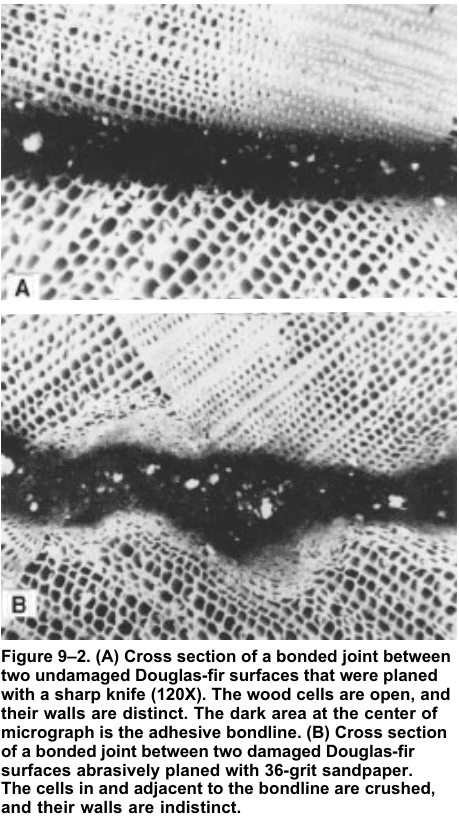
Abrasive planing with grit sizes from 24 to 80 causes surface
and subsurface crushing of wood cells. Figure 9–2 shows
cross sections of bondlines between undamaged, knife-planed
Douglas-fir lumber compared with surfaces damaged by
abrasive planing. Such damaged surfaces are inherently weak
and result in poor bond strength
In other words if the surface is not cleanly cut or sanded
1/ the broken edges prevent the glue mix from entering the cells which reduces surface area.
2/ Any bonding that does happen is to timber that is already broken and crumbled by poor preparation.
Here is the source document
Source: Forest Products Laboratory. 1999. Wood handbook—Wood as an engineering material.
Gen. Tech. Rep. FPL–GTR–113. Madison, WI: U.S. Department of Agriculture, Forest Service,
Forest Products Laboratory. 463 p.
NOTE – this is not a problem solved by adding solvents to the glue
The end result of thinning glue or resin is that there is less glue per unit volume of timber once the solvent dries. This leaves a weaker glue substrate.
