
These practical wooden boat repair methods and epoxy techniques solve typical build problems to save time and material. Learn how to work with epoxy resin, fiberglass, and plywood for home boatbuilding, restoration, and racing preparation.
Each article focuses on established methods to ensure structural integrity, durability, and long-term rot resistance.
The guides cover common workshop challenges, including reliable epoxy bonding, safe handling, glass tape reinforcement, and correct hull repair procedures. The emphasis is on simple, repeatable processes that produce light, strong structures without unnecessary weight or expense.
Browse the categorized topics below to find clear technical solutions for repairs and construction. The material reflects decades of practical boat design and shop floor experience, aimed at helping builders achieve sound results.

Choosing epoxy, glues and rot prevention
Is epoxy worth the extra cost on a plywood boat?
Yes. Pre-epoxy plywood dinghies leaked by year 3–5; epoxy boats need a light sand every 5–10 years. Epoxy vs other glues – a 30 year review
Can a first-time builder get good results with epoxy?
Absolutely. Across hundreds of boats tracked, epoxied vs non-epoxied is chalk and cheese. Epoxy vs other glues – a 30 year review
Does epoxy stop water vapour getting into the wood?
High-solids epoxy does: sealed Sabres gained no measurable weight in a season, against 6–8 lb before. Three coats, every surface. Epoxy vs other glues – a 30 year review
Can I use PL Premium, polyurethane or Titebond instead of epoxy?
They have a place, especially with cheap North American ply and quick builds, but epoxy’s gap filling is the fail-safe. Epoxy vs other glues – a 30 year review
Is resorcinol better than epoxy for boatbuilding?
Only with tight fits and high clamping pressure. Epoxy is the one reliably gap-filling glue; old resorcinol boats show gaps. Epoxy vs resorcinol glues
Is my old resorcinol-glued boat coming apart?
Common: on 1950s–70s ply boats, many show stringers and other components sprung off the ply. Resorcinol applied with correct clamping pressure and really good fits is a very good glue, but many amateurs can’t achieve that level. Epoxy vs other glues – a 30 year review
Can I use polyester resin on a wooden boat?
Not reliably: polyester tape either sticks or peels off, and the wood underneath is often saturated. Epoxy vs polyester resin for wood
Will a handful of salt inside the boat stop rot?
No. Salt holds moisture; it evaporates, condenses as fresh water up high and rots the deck structure. Preventing rot – the good, the bad and the fugly
How do I stop rot in a plywood boat?
Deny it moisture or air: epoxy-coat all timber so the inside can be mopped dry, and ventilate. Preventing rot – the good, the bad and the fugly
How should I store a wooden boat outside?
Upside down off the ground, inspection ports open, tarp held clear so air moves, drain plug out. Preventing rot – the good, the bad and the fugly
Is it worth epoxy coating an old, finished boat?
Often not in labour once decks are on and paint must come off. How much do you love the boat? Preventing rot – the good, the bad and the fugly
Is CPES or penetrating epoxy good for preventing rot?
No. Solvent leaves pathways; water uptake is about 5× that of high-solids epoxy (35% vs under 8%). Epoxies that soak in – CPES and Everdure
How many coats of epoxy does plywood need?
Three: the first soaks in, the second catches dry spots, the third covers misses. Epoxies that soak in – CPES and Everdure
How do I tell if an epoxy is good quality?
Sniff it: no thinners smell. Cheap industrial epoxies are thinned and brittle; good ones tested 40–50% stronger. Epoxies that soak in – CPES and Everdure
Can I fix shallow rot by soaking it with thinned epoxy?
Only a thin surface layer, with a non-evaporating diluent. If 30–50% of a member is rotten, replace or scarf. Epoxies that soak in – CPES and Everdure
Is 1:1 epoxy OK for boatbuilding?
Fine for furniture. Boats need standard uneven-ratio epoxy plus fillers: stronger and adjustable to the job. Is 1:1 epoxy OK for boatbuilding?
Why can’t I just use a pre-thickened epoxy for everything?
You can’t thin it for end grain or stiffen it for vertical fillets; one mix doesn’t fit every joint. Is 1:1 epoxy OK for boatbuilding?
Do I need screws in a stitch-and-glue or epoxy boat?
No, if the joints have bonding area. Temporary drywall screws, out within a couple of days. Are screws needed in epoxy/wood construction?
How do I get a screw out that’s glued in with epoxy?
Heat it with a soldering iron for 30–60 seconds, then unscrew. Are screws needed in epoxy/wood construction?
Where should I still use fasteners?
Where timber can split off one face (gunwales, skids), and in oily timbers like teak. Are screws needed in epoxy/wood construction?
How big should a fillet or bonding area be on a ply joint?
2.5–3× the thinner ply’s thickness, from fillet or timber. Are screws needed in epoxy/wood construction?
How common is epoxy allergy, and who gets it?
Uncommon: roughly 5 in 1000 small-boat builders, perhaps 15 in 1000 on big boats. Those sensitised mostly worked big projects through cold winters in heated tents, often changing to fresh respirator filters too late. Avoiding epoxy allergies
How do I avoid becoming allergic to epoxy?
You can’t control susceptibility, only exposure: keep it off your skin, ventilate, and never clean skin or clothes with solvents. Shorter builds limit total exposure, the article has advice. Also some mix ratios may be less allergenic for those having early symptoms. Avoiding epoxy allergies
Using epoxy and glass
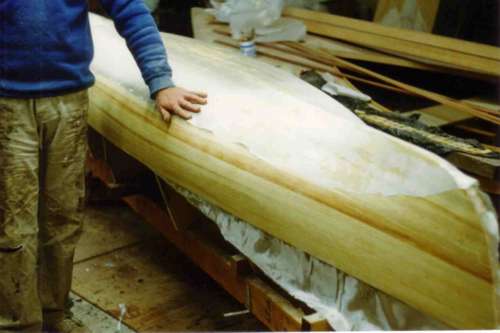
How do I fibreglass the chines on a plywood boat?
Tape the seams in one process: lay tape into wet epoxy and roll it down. Fibreglassing method 1 – small areas
Can I glass and coat other parts of the boat in the same session?
Yes; taping and coating non-glassed areas as one wet-on-wet job saves sanding between. Fibreglassing method 1 – small areas
Why does my glass tape bubble at corners and edges?
Woven tape won’t turn tight curves; cut your own double-bias tape and it lies flat. Fibreglassing method 2 – double bias tape
Where can I get double-bias tape, or make it?
Make it from cloth cut on the bias; the article shows how. Fibreglassing method 2 – double bias tape
My epoxy goes off before I finish glassing a big area. Do I need a slower hardener?
It is more likely to be work practice, not hardener speed: set up each stage before you mix. Fibreglassing method 3 – large areas
How do I glass a whole hull or a canoe without panic?
Be methodical: prepare, wet out, lay cloth and squeegee in planned stages, working along the boat. Fibreglassing method 3 – large areas
Why does my epoxy go off before I can use it?
Method, not hardener. Dry fit and mask first, mix smaller batches, and get it out of the pot onto the job straight away, because it heats up and gels in the tin. Done right you get 30 minutes or more; brushing from the tin gives 5–10. Roller, squeegee or brush
Roller, squeegee or brush for epoxy coating?
Rollers and squeegees for speed on coating and glassing, then a cut-down brush for detail. For gluing, pipe from a bag and spread with the side of a stick like a butter knife. Roller, squeegee or brush
Should I epoxy coat plywood before or after assembly?
Before has advantages: precoat flat sheets, masking the glue lines; you can even sand them ready for varnish or paint. Faster, less epoxy, easier sanding. Saving time by precoating plywood with epoxy
Do I need to sand between coats of epoxy?
Not if the next coat goes on wet-on-wet, before the first cures. Reducing labour and waste when using epoxy
How do I stop wasting so much epoxy?
Mix small, place it accurately, glue in one hit, smooth with cut-down brushes. Reducing labour and waste when using epoxy
How do I make epoxy fillets neatly with less mess?
Pipe peanut-butter-thick epoxy from a bag with one corner cut off (disposable icing bags now work better than snap-lock bags), shape it with a rounded filleting stick, and lift the excess with a chisel-pointed stick or masking tape. Piping bags for filleting and gluing
How big should an epoxy fillet be?
Radius about 3× the thinner ply: an 18 mm radius for 6 mm ply. Piping bags for filleting and gluing
Paint or varnish over epoxy?
Paint protects epoxy and timber best; varnish is faster and needs fewer coats over epoxy. Painting and varnishing over epoxy
Does epoxy need UV protection?
Yes; paint or varnish with UV resistance over it, since epoxy breaks down in sun. Painting and varnishing over epoxy
One-pot or two-pot paint for a small boat?
Two-pot is more hassle, but more durable; get the right brushing thinners to make it easier. Painting and varnishing over epoxy
I don’t own many clamps. How do I glue a boat together?
Use a cordless drill with a clutch and temporary screws instead of dozens of clamps. Cordless drills instead of clamps
How do I lay a teak deck over plywood?
Epoxy or Sikaflex with the oily-timber precautions; the article has the trick. Teak decks over plywood
Why is my epoxy still soft after two days?
99.9% operator error: wrong ratio, poor mixing. Less likely but possible is cold or a dropping temperature after application. Sometimes low density mixes (microbaloons) have moved resin molecules further apart so there is no accumulation of reaction heat. The article lists the fixes. Why hasn’t my epoxy cured?
What do I do with epoxy that never cured?
Options depend on cause; usually scrape it off and redo – learn the magic of cabinet scrapers. Why hasn’t my epoxy cured?
Should I rough up wood with coarse sandpaper so epoxy grips?
No. Coarser than 100 grit tears fibres and causes bond failures because of gluing to already fragmented and broken timber structure; sharp tools are fine. Never sand coarser than 100 grit for gluing
What grit before painting or varnishing bare timber?
Also no coarser than 100, as deep scratches show through; move up to 180 and then 280 with later coats. Never sand coarser than 100 grit for gluing
How do I use epoxy in a cold workshop?
Keep resin and hardener warm in a lightbox, a box with a bulb inside; some even add a simple thermostat. A lightbox to keep epoxy warm
Why won’t my epoxy pump or spread when it’s cold?
It thickens; warm it. Almost all thinners destroy the waterproofness of epoxy. A lightbox to keep epoxy warm
Why did my scarf joint fail?
End grain sucked the epoxy out and starved the joint – learn the 2-step process and you still only need 1 epoxy mix. Epoxy gluing end grain and scarf joints
How do I glue a scarf in plywood properly?
Brush neat epoxy/hardener mix on the end grain first, then add powder to the rest of the epoxy, mix well and glue normally. Epoxy gluing end grain and scarf joints

Repairing and restoring old boats
I bought an old plywood dinghy. Where do I start?
Decide first whether it’s a keeper, then triage: fix what stops it sailing, leave cosmetics for later. Fixing up old plywood boats
How do I fix a hole or dent in a plywood boat?
Patch and glass, working in a slight hollow so the repair nearly disappears. The compilation shows it with photos. Fixing up old plywood boats
Is an old racing dinghy worth restoring, or should I walk away?
Check the article’s keeper test before spending money. Restore or ditch an old racing dinghy?
What should I fix first on an old dinghy, and what can wait?
Triage: watertightness and structure now, finish later. Minimal repairs to an old Mirror dinghy
How do I restore an old Mirror dinghy?
Minimal repairs to keep it going; the article shows what was fixed and what was left. Minimal repairs to an old Mirror dinghy
Can a cheap old Cadet, Sabre or Heron be made competitive?
Yes; a carefully selected cheap boat can become a fast performer with the right fixes. Restoring an International Cadet
How do I replace the whole bottom of a plywood boat?
Overnight regatta fix – with no permanent fasteners, rout the old bottom off and fit a precoated panel. Replace a bottom overnight – fast repairs
My centreboard case keeps wearing, and my rudder and centreboard are getting chewed up.
Pad the case and rudder box cheaply to cut board and case maintenance. Centrecase padding
How do I get oil or diesel out of a wooden hull?
The article gives the removal method so epoxy and paint will stick again. Removing oil and diesel from timber
Can I glue or paint over timber soaked in diesel?
Not until it’s removed; contamination stops bonding. Removing oil and diesel from timber
Can I use silicone sealant on my boat?
Don’t. Ugh – it contaminates surfaces so paint or varnish bubbles randomly on the rest of the boat. Why I hate silicone on boats
What sealant should I use instead of silicone?
The best sealers are polyurethane. One brand is Sikaflex. Why I hate silicone on boats
How do I size a piece of timber in my traditional workboat or cruiser?
Use the USL Code scantling tables, which are the reference for how many older commercial boats were built. The USL Code for traditional boats
Can I use bamboo for a small boat’s mast or spars?
Guidance is on the Open/Oz Goose site – there are many types of bamboo and some spars work better than others. Bamboo spars (Oz Goose site)
How do I make paint or varnish non-skid cheaply?
Sprinkle coarse sugar into the wet coat and wash away the sugar next day; good grip, nothing sharp. Cheap non-skid paint or varnish
Timber, strip planking and building faster
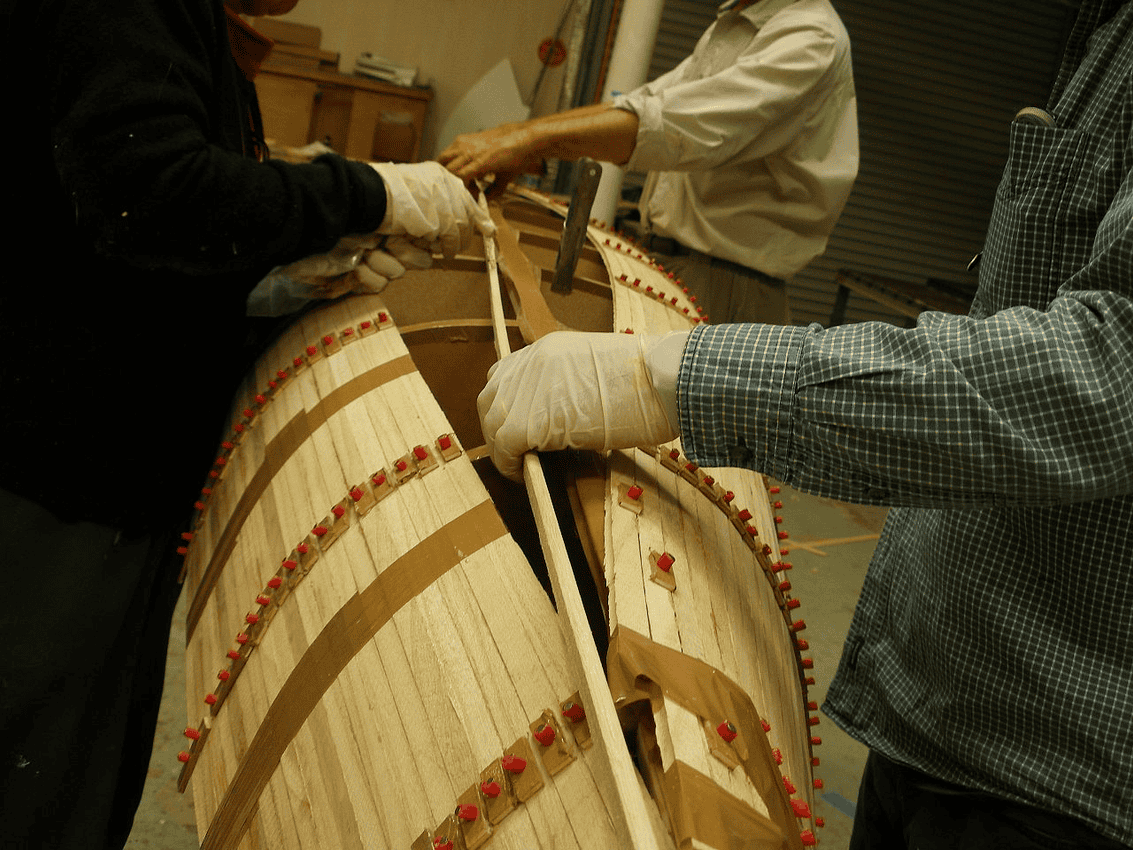
How do I get a strip-planked hull or deck smooth, not lumpy?
Use a torture board: a long sanding board stiff enough to bridge the hollows so it cuts only the highs. You can’t see the small differences, so let the board decide. Torture board hull fairing
How thick and long should a torture board be?
Bend is critical. 3 mm ply is far too floppy; 6 mm (8× stiffer) or 9 mm (27× stiffer) suits most hulls, 4 mm for canoe bilges. Leaning on it, only the last 12 mm or so of each end should lift. Keep it about 800 mm long to spare your wrists. Torture board hull fairing
How do I fill big hollows when fairing?
Screed filler with a notched trowel whose gaps are narrower than the feet. Sand until much of the surface is back to the original, then fill between with tinted filler so you can see where the last stage ended. Torture board hull fairing
How light can a strip-planked canoe be built?
An 11 ft (3.3 m) Wee Lassie in 7 mm balsa strips with 75 gsm (2 oz) glass weighed 12 lb (5.5 kg). It lasted, and was sold after two years of use. The 12 lb balsa canoe
Should I use thinner strips to save weight?
No. Stiffness comes from timber thickness, and timber is the lightest part of the hull. Keep 6–7 mm strips; save weight with lower-density timber and lighter glass. The 12 lb balsa canoe
What weight of glass for a strip-planked canoe?
4 oz (135 gsm) suits a family canoe; 6 oz is fine and easier to buy. Light glass gives the cross-grain strength; heavier glass only adds dent resistance against stones and snags. Sometimes an extra layer can be added in wear or pressure zones. Timber selection for strip planking
What timber should I use for a strip canoe or kayak in Australia?
Cedar and Oregon are now premium. Plantation paulownia is cheap, light and works at the same 6 mm as cedar. Keep heavy jarrah to thin capping strips on keels and wear areas, replaceable when chewed. I’ve even played with balsa! Timber selection for strip planking
Is paulownia (kiri) any good for boatbuilding?
Yes. A relatively new, light, plantation-grown timber, usually cheaper than western red cedar, with significant weight saving. A 16 ft Goat Island Skiff dropped from 130 lb to 105 lb (59 to 48 kg) using it for framing. Paulownia for lighter structures
Does paulownia need bigger sizes than cedar?
Barely. Cedar is about 1.2× stiffer, so a stringer working on its own needs to be about 6% deeper, same width. Where ply bonds to two faces and seams are taped, use cedar sizes. Paulownia for lighter structures
Does timber need to be dry before epoxy work?
Yes; epoxy only works reliably on air- or kiln-dried timber, and kiln drying only reaches about 50 mm (2 in) deep. Wet strips glassed on one side can curl like a dry leaf. Epoxy vs other glues – a 30 year review
Should a plywood deck join sit on a deck beam?
Never. A foot between beams levers the ply edge off the beam at about 16:1 and breaks the joint. Use a 6:1 epoxy scarf or a butt strap 20× the ply thickness (180 mm for 9 mm ply). Never join a ply deck on a deck beam
Plywood or laid deck when restoring a classic boat?
Plywood carries rigging loads as one piece, costs less and goes on faster; laid decks work their caulking until they leak. Keep a laid deck if the boat is historically significant or you love the tradition. Or read our page on teak veneer decks. Never join a ply deck on a deck beam
What glass goes over a plywood deck?
Talking yachts – woven cloth, never chopped strand mat, in good boatbuilding epoxy. For a Tumlaren-sized keelboat, 9 mm ply with 300 gsm (10 oz) cloth; it ends up looking like a canvas deck. Never join a ply deck on a deck beam
Can I use duct tape instead of wire or cable ties to stitch a hull?
Yes. Two Quick Canoes for a Loire trip were held together with gaffer tape. A taped dummy butt strap screwed through the join lets you handle panels before the glue cures. But it doesn’t work when hull panels are heavily twisted or thicker than 6 mm (1/4 in). Two Quick Canoes in a week
How fast can a plywood canoe be built?
A Quick Canoe took about 12 hours of work; two were built in a week on a trip. Butt straps are a one-hit joint, and wet-on-wet epoxy cuts the waiting. Two Quick Canoes in a week
What are the fastest ways to build a small wooden boat?
Think big: I like plywood because the boat can have many fewer components – a Goat Island Skiff hull is 10 ply parts. It also makes repair faster, by routing out whole panels rather than fiddling with bits. Why I hate boatbuilding – kind of
Why does my half-built stitch-and-glue hull feel floppy?
Don’t worry. Knees, end tanks or side tanks set the corner angles, gunwales and inwales spread stiffness, and seats and mast partner finish the job. If it doesn’t twist under sail, it’s stiff enough. Frank’s floppy Kombi canoe
Can I build a canoe in 4 mm ply instead of 6 mm?
Canoes have been built for decades in 4 mm with only taped seams and no glass at all. However, light 75 gsm (2 oz) glass on foot-pressure panels turns the ply into a sandwich. Check against the specific plan. Frank’s floppy Kombi canoe
I keep seeing mistakes in my build. Should I redo them?
You judge your work from inches away; from a few metres the boat will wow people. Fix what worries you enough to act on and let the rest go. Class students typically speed up threefold once they’ve seen another student’s mistake fixed. Boatbuilding mistakes and perfectionism

Plans, design and strength
Can I scale a boat plan up or down by 10–15%?
Not safely. That rule of thumb is a myth, because you can’t see where the design sits in its envelope. A Goat Island Skiff cut from 4.7 m to 4 m (15 ft 5 in to 13 ft 1 in) lost its stability and capsized on its first tack. Ask the designer first. Honey, I shrank the boat
Can I swap the wooden spars for aluminium tube?
Not without thinking about the wall thickness. Weight up high hurts, but stiffness hurts more: wooden spars are designed to flex in gusts so the boat accelerates instead of staggering over. Honey, I shrank the boat
Are old or free boat plans worth building?
Plans by real designers like Hartley still work, but 50-year-old construction uses far more timber and labour. “Hundreds of plans on CD” are mostly old magazine plans resold by people who don’t know boats; almost all are free online anyway with a bit of looking. Are free plans OK?
What should I know before buying a boat plan?
Agents steer you toward designs they know, which helps first-timers; arrive with a clear idea if you want something specific. Buy from someone who builds and answers questions during your build. Understanding boat plans options
Do I need a boatbuilding course before my first build?
No. Building with a plans seller who backs you up teaches much the same. Most people are really looking for permission to start. We cover your butt by having detailed step-by-step plans and builders’ groups on Facebook for questions. Understanding boat plans options
Can I butt-join birdsmouth mast staves, or must I scarf?
Scarf them. With 8 staves, one butt gives away about 12% in tension and 25% or more in bending. Butts only get away with it in an overbuilt, heavy mast. Birdsmouth masts – scarf, don’t butt
How thick should a hollow wooden mast’s wall be?
Traditionally 20% of the diameter for a durable mast; 15% for racing, with some risk; below that is experiment and hope, but from experience it sometimes works. Rectangular box sections are lighter for the same stiffness. Birdsmouth masts – scarf, don’t butt
Plywood or strip-planked canoe: which should I build?
Plywood is quicker, lighter and more efficient to build. Strip lets you build classic hollow-ended shapes with great directional stability, and results in a truly collectable boat. Modern glued lap/clinker is halfway between. Sailing and paddling canoes – strip vs plywood
Should I add a keel so my canoe tracks or sails?
Don’t; it ruins a traditional design’s balance. Paddling canoes sail fast with a small rig and leeboard, or outriggers and a big sail. They may not tack well, so keep a paddle handy – or do dinghy roll tacks to lift the ends of the canoe out of the water for a quicker spin. Sailing and paddling canoes – strip vs plywood
Will a golf-ball dimple finish make my hull faster?
No. Golf balls fly on spin plus dimples. On a boat, a fair, smooth surface that keeps laminar flow longer on the foils and forward hull is what cuts drag. Do golf ball dimples make boats faster?
Are dories really seaworthy?
Heavy traditional dories coped, but were notoriously tippy until half-loaded with fish; Gloucester records show capsize drowned more dorymen than fog. Light modern dories lose the weight that gave stability. Rounded sides give much more stability. Are dories really seaworthy?
How do I build a strip kayak or canoe that survives rocks and surf landings?
Keep the timber thick and light: 7 mm paulownia matches 6 mm cedar for impact. Double light glass where the boat touches ground, inside and out. A hit hard enough to break one timber breaks them all. Strip canoes that handle impact
How much fibreglass protects a plywood canoe from rocks and logs?
Far less than people think: 2 oz (75 gsm) or lighter over the bottom plywood and bilge panels, running 25 mm onto the topsides, which also replaces outside chine tape. Having glass matters more than its weight. And why did glass on small boats become an arms race? How much glass prevents damage?
What plywood thickness should a small boat use?
4 mm (3/16 in) is the most common across Australian plywood dinghies; 6 mm on a dinghy bottom saves fitting runners; 6 mm for canoes. Gaboon ply cuts about a quarter of the hull weight. Plywood boat strength and stiffness
Why does my plywood hull oilcan or twist?
Fix it with structure, not thicker ply: closed buoyancy tanks act as torsion boxes. 4 mm OzRacers showed no twist with two people standing on opposite corners. Typical hull weight is 8–10 lb per foot (12–15 kg/m). Plywood boat strength and stiffness
SAILING and learning to sail – how to get control of the boat.
This Section Sponsored by our
Really Simple Sails Sailmaking

Learn to sail – choosing a first boat
How to choose a first boat – Should I buy new, build or buy secondhand?
TABLE OF CONTENTS – Sailing Lessons
Our Growing list of Free Online Sailing Lessons – more approx weekly

FUNDAMENTALS
Tiller and How to feel the sail
Fundamentals 1 – Lesson on Tiller handling for Sailboats
Sailing Lesson 1 Manoeuvres
Tacking And Gybing – Turning Around – Taking the pressure off.

Safe Gybe Technique and Fast Gybe Techniques.
Sailing Lesson 2 Upwind
Basic Sailing Upwind – Light and Moderate Conditions
Sailing Upwind in Gusty Conditions – when a gust hits.
Sailing Upwind in Gusty Conditions – when a gust ends (Technical)

Sailing Lesson 3 Downwind
Some useful sailing tips for beginner sailors
Some basics of learning to sail that often get ignored at the beginning.
How to make it easy to get kids to wear life jackets – and a how the world’s best sailor drowned.
Why wearing lifejackets is essential – and how to get kids to wear their lifejackets!!!
Some more advanced rigging, boat handling and sailing tips and tricks
Construction and Building Questions from the Early OzRacer days.
Relate to OzRacer, OzGoose and general boat construction and sailing.

The Sailing Gear Arms Race and the Oz Goose
Why exotic second hand parts of other boat should not be used on low cost boat types
Hull Structure for Plywood Boats

How light can a OzRacer be built of wood and epoxy
? 10kg/25lbs?
The Death of Small Boat Sailing in Australia. TOO EXPENSIVE.
Designing sailboats to be stiff. Oilcanning and Twisting and the role of torsion boxes – epoxy for wooden boats including repairs
Plywood, Thickness, puncture protection

What are the correct plywood thicknesses for robust small boats
Peter on how much resistance to puncture does ply really need to have
Centerboards and Leeboards


Building an OZ Goose. Trying to figure out the waterline as the sailboat will probably be in the water for 4 months and I want to use bottom paint on it.
Hi Rick,
Waterlines are well and good, but as an old time boat painter they really are only the starting point.
Normal gloss marine paints are fine for a week of immersion without any problems at all. If the right process is followed they won’t suddenly fall off or anything dramatic. Towards the end of the week they will start to get slime – which is not hard to remove, but it establishes a ecosystem for coral worm, weed, barnacles to survive in.
So if much more than a week without being used then will need an antifoul paint. Be aware there are many types … you need one that is suitable for trailerable boats which does not deteriorate out of the water for extended periods.
Using a boat regularly is a great way of keeping growth away. Also if the boat dries out (eg tide goes out or pulled up on a beach) for a couple of hours a day then it will be OK for much longer.
When empty with mast up the Oz Goose will sit in the water bow down. So the paint needs to go up to the front end of the bottom. if there is ever gear left in the hull or the mast is left out the bottom will be wet its full length from wave splashing.
So I recommend that the bottom paint go from the bottom corner of the bow transom to the bottom corner of the stern transom.
This is not unusual. As if you use the waterline itself to paint a yacht – the yacht will sit bow down on the mooring because of no weight in the cockpit and the weight of the mooring chain. But sit stern down or on its lines when sailing. So the normal thing is to have the paint higher than the waterline at the front by a few inches and only higher than the waterline at the back by half that. BUT if the boat has flat areas where the water will splash around continuously then that needs to be protected too. Often the top edge of the bottom paint is not straight, but a subtle curve rising in the ends a bit.
MIK
Greetings Michael,
I’m half-way through the hull build – & enjoying your plans!
Do you have dimensions for an aluminium mast for an Oz Goose – that has proved to be a suitable match for a Realy Simple Sail from Duckworths?
Would 40mm x 1.6 do the job – or 40mm x 2mm?
Cheers, & sincerely,
Tony.
Hi Tony,
The information you need is on this page. Interestingly (and a little bit obviously when you really think about it) the outer diameters need to be pretty close to the wooden values.
The full information is on our sister site.
https://www.opengoose.com/building-a-goose/materials/substituting-aluminium-spars-on-the-oz-goose-sail-boat/
Best Regards
MIK
would it be ok to lower the goat island skiff by two inches and change the blunt bow to an angled bow?
Hi Chris,
Why do you want to change it?
I’m guessing the hull height is something to do with the plywood widths you have available?.
Michael